

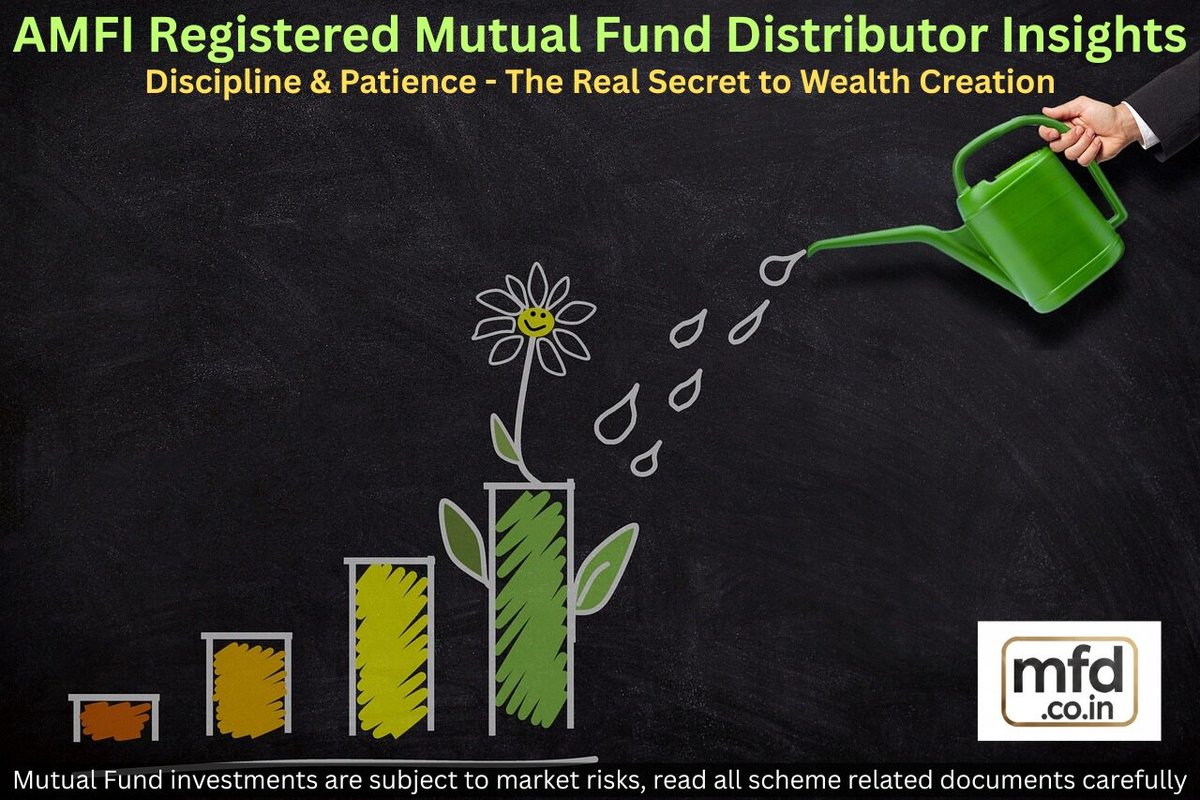
Building long-term wealth through mutual funds is rarely about finding the “perfect” scheme or timing the market perfectly.
Most investors who succeed over 10–20+ years eventually realize the same truth: discipline and patience matter far more than chasing high returns, hot tips, or frequent switching.
As an AMFI-registered mutual fund distributor, I have seen this pattern play out repeatedly:
Investors who remain consistent through market volatility usually end up in a much stronger position over time. Those who stop SIPs during corrections, chase recent performers, or try to time entries and exits often regret those decisions later.
This educational article explains why discipline and patience form the real foundation of wealth creation, and how you can make these habits work for your own financial goals.

Mutual fund investments are subject to market risks, read all scheme-related documents carefully.
Author Amit Verma
AMFI-Registered Mutual Fund Distributor (ARN-349400)
This content is purely educational and does not constitute investment advice, recommendation, or solicitation. For personalized guidance based on your financial situation, risk profile, and goals, please consult an AMFI-registered mutual fund distributor or SEBI-registered investment advisor.
Why Discipline & Patience Outperform Almost Every Other Strategy
Let’s be honest about something most financial content won’t tell you directly: the biggest enemy of your investment returns probably isn’t the market. It’s you, or more specifically, the very human emotions that kick in when markets get uncomfortable.
Fear and greed have derailed more investment journeys than any market crash ever has. The investor who panicked and redeemed everything in March 2020 didn’t just miss the subsequent recovery, they locked in real losses and then had to decide when to re-enter a market that was already bouncing back sharply. That’s an almost impossible position to recover from psychologically, let alone financially.
Discipline and patience exist precisely to protect you from these moments.
Discipline removes emotion from investing
Markets swing constantly between two powerful forces: fear during sharp corrections and greed during euphoric rallies. Most emotional investment decisions happen at exactly the wrong moments, selling when markets are down, buying when everything has already run up.
Discipline breaks this cycle. It looks like continuing your SIP even when every headline screams crisis or impending recession. It looks like ignoring the urge to redeem when your portfolio is temporarily down 15%. It looks like not chasing that thematic fund your colleague keeps talking about just because it delivered 40% last year.
None of these disciplined actions feel exciting or clever in the moment. But over years and decades, they compound into something remarkable.
Patience lets compounding do its work
Here’s something most people understand intellectually but don’t truly feel until they’ve lived it: wealth creation is not a straight line. It’s exponential. And the exponential part only kicks in meaningfully after years, sometimes a decade or more, of staying invested.
In the early years of your SIP, progress feels slow and almost underwhelming. You invest ₹5,000 monthly, markets go up and down, and your corpus doesn’t seem to be going anywhere particularly impressive. Then somewhere around year 8 or year 10, something shifts. The compounding effect starts to become visible. By year 15 or 20, it can feel almost unbelievable, the growth in a single year exceeds what you contributed in the previous five years combined.
But that magic is only available to the patient investor who showed up consistently through the boring middle years when nothing felt exciting.
Most investors struggle more with behaviour than with returns
This isn’t just an observation from personal experience, investor behaviour studies across multiple markets consistently show the same pattern. The returns that mutual funds generate are often meaningfully higher than the returns that actual investors in those funds experience.
Why? Because real investors don’t stay invested the way a fund’s track record assumes. They panic-sell during downturns. They chase the fund that just had a great year. They switch frequently, missing recovery rallies in the funds they just exited.
Panic-selling during downturns doesn’t protect capital, it crystallizes losses and removes you from the market at exactly the point when staying invested is most valuable. Chasing recent performance means consistently buying high and selling low, the opposite of every successful investment principle. Frequent fund switching means you’re never in any one fund long enough for its actual strategy to work through a full market cycle.
Discipline and patience don’t just help you earn better returns. They protect you from yourself during the moments when emotional decisions feel most justified.
How Discipline Shows Up in Real Investing Decisions
Staying invested through corrections
Market corrections are not exceptional events, they are a completely normal feature of equity markets. Corrections of 10–20% happen with surprising regularity. Deeper falls of 30–40% or more have occurred multiple times across market history, and they will almost certainly occur again at some point.
The disciplined investor treats corrections differently from the emotional one.
When prices fall, a disciplined investor who continues their SIP is effectively buying more units at lower prices, doing automatically what every investor rationally knows they should do but emotionally struggles to execute. When markets recover, and historically, over long periods, they have, those lower-cost units generate meaningful additional returns.
The impatient investor who stops SIPs or redeems during corrections does the opposite. They stop buying cheap units, often lock in losses by selling, and then face the paralysing question of when to re-enter, usually missing the sharpest early recovery days that disproportionately determine long-term outcomes.
Avoiding frequent fund switching
This is perhaps the most common and costly mistake among investors who are otherwise genuinely trying to do the right thing.
A fund underperforms its benchmark for 12–18 months. The investor grows frustrated, reads comparisons showing other funds doing better recently, and switches. The fund they exit then delivers strong returns over the next two years as its style comes back into favour. The fund they entered trails off after its recent strong run.
Switching funds every 1–2 years based on short-term performance comparisons almost systematically ensures you’re selling funds at relative lows and buying at relative highs, repeated, self-inflicted buy high, sell low.
A disciplined investor instead chooses funds aligned with their goals and risk profile and stays invested for 7–10+ years unless there is a genuinely fundamental reason to exit. Fundamental reasons include things like a fund manager departure after which performance has demonstrably declined, a clear mandate change that no longer aligns with your goal, or sustained underperformance not just against peers but against the fund’s own benchmark over multiple full market cycles.
Short-term underperformance relative to a recent hot sector is not a fundamental reason. It’s noise.
Sticking to asset allocation & rebalancing
One of the quieter superpowers of disciplined investing is systematic rebalancing – and very few investors actually do it properly.
The principle is straightforward: set a target allocation based on your goals and risk capacity, review it once a year, and rebalance back to your targets when your allocation has drifted meaningfully – perhaps when any asset class is more than 8–10% away from its target.
What makes this powerful is that it creates a systematic sell high, buy low dynamic without requiring any market predictions or emotional decisions. When equity markets have run up strongly, your equity allocation will have grown above target, rebalancing means selling some equity at elevated prices and moving into debt or other asset classes. When equity falls sharply, your allocation will be below target, rebalancing means buying equity at depressed prices.
This process happens automatically, according to your written plan, without any market timing or emotional involvement. Over long periods, disciplined rebalancing meaningfully improves risk-adjusted outcomes.
Ignoring short-term noise
The information environment for investors today is genuinely brutal. Financial news runs 24 hours. Social media surfaces every market prediction and crisis headline. WhatsApp groups circulate tips and warnings constantly. TV debates feature experts confidently predicting moves in both directions.
Essentially none of this is useful for a long-term investor, and a meaningful portion of it actively harms your decision-making by creating urgency and anxiety around things that don’t actually matter to your 15-year financial goal.
Disciplined investors learn – sometimes through painful experience – to filter aggressively. The relevant inputs are your own goals and time horizon, your own risk capacity and cash-flow needs, and your written financial plan. That’s genuinely it.
A useful test: before reacting to any market news or investment tip, ask yourself whether this information changes your goals, your time horizon, or your fundamental risk capacity. In almost every case, the honest answer is no – and that answer should dictate your response.
How Patience Turns Small, Regular Investments Into Meaningful Wealth
The real strength of mutual funds lies in time + consistency – not in endlessly searching for the “best” fund.
Illustrative Example (Hypothetical & Educational Only)
Consider two investors making identical ₹5,000 monthly SIP contributions, with one difference – when they started.
Investor A begins at age 25 and continues for 35 years until retirement at age 60, assuming a constant 10% annualized return for illustration purposes only. This is not a projection, guarantee, or prediction – actual long-term equity category returns have varied significantly depending on the period and specific product.
Approximate result:
- Final corpus: approximately ₹1.7–1.8 crore
- Total contributed: ₹21 lakh
- Gains from compounding: over ₹1.4 crore
Investor B begins at age 35 – just 10 years later – and continues for 25 years until the same retirement age, same ₹5,000 monthly, same assumed average return.
Approximate result:
- Final corpus: approximately ₹45–50 lakh
- Total contributed: ₹15 lakh
- Gains: approximately ₹30–35 lakh
Starting just 10 years earlier more than tripled the final corpus – with identical monthly contributions and identical assumed returns.
That difference – over ₹1.2 crore – came entirely from time. Not from finding a better fund. Not from timing the market. Not from increasing the monthly amount. Just from starting 10 years earlier and staying consistent.
Important Caveats:
These are simplified, hypothetical calculations assuming constant average returns, which never happen in reality. Actual market returns vary significantly year-to-year and can be higher, lower, or negative over any given period. Mutual fund investments carry real risk of capital loss. Past performance is not indicative of future results. These figures are presented purely to illustrate the mathematical concept of compounding over time – they should not be interpreted as expectations, projections, or likely outcomes for your investments.
Practical Ways to Build Discipline & Patience
Knowing that discipline and patience matter is one thing. Actually maintaining them through market volatility, negative news cycles, and the temptation of apparently better alternatives is something else entirely. Here are practical approaches that genuinely help.
Set clear, written goals
Vague intentions don’t survive market corrections. Written, specific goals do.
Define what you are investing for, when you need the money, and roughly how much you need. A goal like “daughter’s engineering education – target ₹25 lakh by 2035” gives you something concrete to anchor to when markets are uncomfortable and the temptation to change course is strongest. Abstract intentions to “grow wealth” don’t provide that anchor.
When you know exactly what you’re investing toward and when, short-term market noise stops being threatening and starts being irrelevant.
Automate everything
Automation is one of the most effective tools for building investment discipline because it removes decision-making from the equation entirely.
Set up SIPs to execute on your salary date – before discretionary spending gets a chance to compete. Consider a step-up SIP that automatically increases your contribution by 10–15% annually as your income grows, building larger investments without requiring repeated active decisions. Enable automatic reinvestment of gains and dividends so compounding proceeds without interruption.
Every time you remove a recurring active decision from your investment process, you remove an opportunity for emotion or distraction to interfere.
Build an emergency fund first
This point sounds basic but is genuinely critical to maintaining investment discipline over the long term: keep 6–12 months of living expenses in liquid or low-risk instruments completely separate from your investment portfolio.
The reason this protects discipline is straightforward. When a genuine emergency strikes – job loss, medical emergency, urgent home repair – investors without emergency funds are forced to redeem long-term investments, often at exactly the wrong moment during market weakness. One forced redemption during a downturn can undo years of disciplined investing and psychologically break the habit entirely.
An adequate emergency fund means your long-term investments can stay undisturbed through life’s inevitable disruptions.
Review annually – not constantly
Daily or weekly portfolio checking is one of the most reliable ways to undermine investment discipline. It keeps short-term volatility constantly visible, making normal fluctuations feel like crises and creating the psychological pressure to “do something.”
A structured annual review – checking goal progress, fund performance relative to relevant benchmarks, and asset allocation – provides all the genuine information you need without the constant noise. Set a calendar reminder, do your review once a year with clear criteria, and close the portfolio app for the other 364 days.
The less frequently you check, the less opportunity volatility has to provoke emotional decisions.
Accept volatility as normal
Perhaps the most important mindset shift for a long-term equity investor is genuinely accepting – not just intellectually acknowledging but actually internalising – that significant volatility is not an aberration. It is the normal operating environment of equity markets.
Corrections of 10–20% occur with surprising frequency in equity markets. Deeper corrections of 30–50% have happened multiple times across market history. These declines are uncomfortable, sometimes frightening, and occasionally correlated with genuinely difficult economic circumstances. They are also temporary features of markets that have historically trended higher over long periods – though past trends provide no guarantee of future outcomes.
An investor who expects volatility and plans for it psychologically is far less likely to make fear-based decisions during the inevitable difficult periods. An investor who expects steady upward progress and is shocked by corrections is far more likely to panic at exactly the wrong moment.
Document your plan
Write down your target allocation, a simple rebalancing rule, and a rough approach to de-risking as key goals approach.
This document serves a specific and important function: it gives you something authoritative to refer to during volatile markets and emotional moments when the temptation to deviate from your plan is strongest. During a sharp market correction, it’s far easier to stay the course when you can read your own written rationale for why you made the allocation decisions you made.
Without documentation, even well-reasoned investment plans are vulnerable to being abandoned during uncomfortable moments.
Why Most People Struggle With Discipline & Patience
Understanding why something is hard is often the first step to addressing it effectively.
We are fundamentally wired for instant gratification. Our instincts and emotional systems evolved in environments where immediate responses to threats and opportunities were essential. Long-term investing asks us to do the opposite – to ignore immediate emotional signals and stay committed to outcomes that are years or decades away. That runs against powerful, deeply ingrained tendencies.
Social media and financial news amplify exactly the wrong stories. Extreme success stories get shared because they’re exciting. Crisis narratives get engagement because they trigger anxiety. The boring, consistent investor who simply kept their SIP running for 20 years and ended up financially comfortable generates no content at all – but that story is far more representative of how wealth is actually built.
Social environments create genuine pressure through FOMO. When friends and colleagues talk about investments that have recently done spectacularly well, the quiet discipline of staying in your existing diversified portfolio feels almost embarrassing by comparison. This social pressure is real and should not be underestimated as a risk to investment discipline.
The antidote to all of this is structure and process rather than willpower alone:
Clear written goals that remind you what you’re actually working toward. Automated SIPs that execute without requiring repeated active decisions. A fixed annual review schedule that channels the urge to “do something” into a structured process. Professional guidance when emotional pressure or uncertainty is genuinely high.
Discipline is not a personality trait that some people have and others don’t. It’s a system. Build the right system and discipline largely takes care of itself.
Final Thought from an AMFI-Registered Mutual Fund Distributor
Wealth creation is rarely about luck, perfect timing, or genius-level fund picking.
It is usually about doing simple things extraordinarily consistently – for a very long time.
After years of working with investors across different life stages and market cycles, what I’ve observed is this: the investors who look back with satisfaction at their financial journey are almost never the ones who made spectacular calls or found hidden gems. They’re the ones who started early, automated their investments, resisted the urge to interfere during difficult periods, and let time and compounding do what they do best.
Discipline keeps you invested when everything around you is suggesting you shouldn’t be.
Patience allows compounding to work in your favour when nothing about the near-term looks promising.
Together, they form the real, underappreciated edge that separates long-term success from regret.
Want help building a disciplined, goal-based plan that matches your life stage and risk capacity? You’re welcome to reach out – no obligation, just clarity.
📱 WhatsApp: +91-76510-32666 🌐 mfd.co.in/signup
Disclaimer
Mutual fund investments are subject to market risks, read all scheme-related documents carefully.
This article is purely educational and does not constitute investment advice, recommendation, or solicitation. Past performance is not indicative of future results. Actual returns can be higher or lower and may be negative. Tax laws are subject to change – consult a Chartered Accountant for guidance specific to your situation. Investment decisions should be based on your personal financial situation, risk tolerance, time horizon, and goals after proper assessment. For personalized guidance, consult an AMFI-registered mutual fund distributor or SEBI-registered investment advisor.
About the Author
Amit Verma
AMFI-Registered Mutual Fund Distributor (ARN-349400)
As an AMFI-registered mutual fund distributor, I may receive commissions on investments in Regular plans of mutual funds. These are paid from the scheme’s expenses (TER) and are not charged to you separately, but they can affect net returns over time. You can independently verify ARN-349400 on amfiindia.com.
For personalized investment guidance:
- Visit: mfd.co.in/signup
- Contact: +91-76510-32666
- Email: planwithmfd@gmail.com
- Website: mfd.co.in
Linkedin: https://www.linkedin.com/company/mutual-fund-distributor-in-india/
 When Should a Freelancer Move to a Formal Business Structure?