
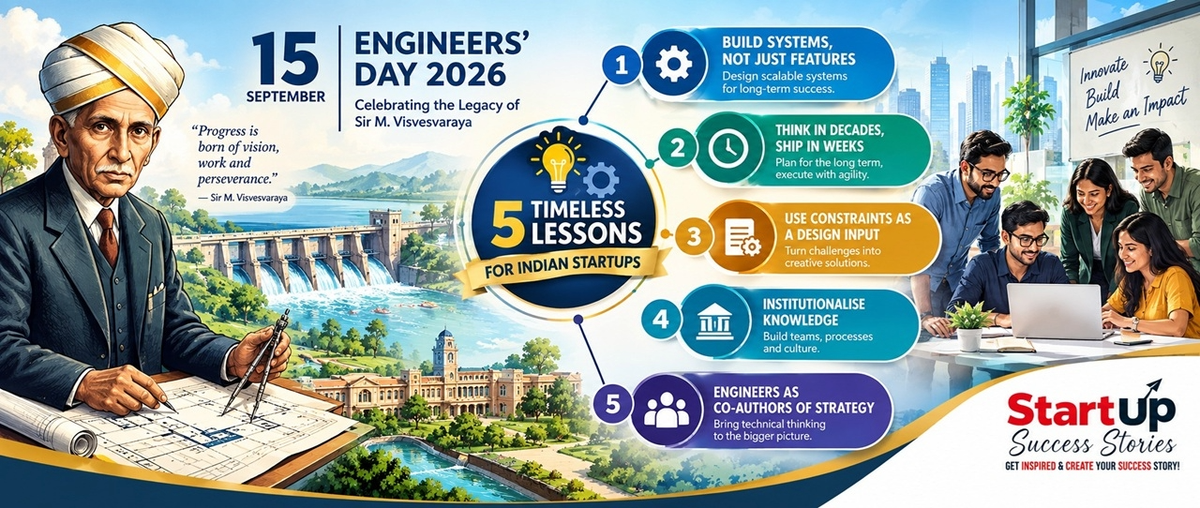
On 15 September, India celebrates Engineers’ Day, marking the birth anniversary of Sir M. Visvesvaraya. For founders, this isn’t just a tribute to civil engineers; it’s a reminder of how an engineering mindset shapes ventures that last.
Engineers don’t just build products. They build the systems that make startups scale, and few figures illustrate that better than the man India built this day around.
Who Was Sir M. Visvesvaraya, and Why Should Founders Care?
Mokshagundam Visvesvaraya was born on 15 September 1861 in Muddenahalli, a village in what was then the princely state of Mysore, Karnataka. He trained as a civil engineer and went on to become one of the most consequential builders, literally and institutionally, in modern Indian history.
His engineering résumé alone would justify the tribute: he patented an automatic sluice-gate system, first installed at the Khadakvasla reservoir near Pune in 1903, that regulated reservoir water flow and prevented flooding while protecting structural integrity. He later applied similar block-system irrigation thinking to the Krishna Raja Sagara (KRS) Dam across the Cauvery river, built between 1911 and 1931, which turned drought-prone Mysore agricultural land into some of the region’s most productive farmland – a project Mahatma Gandhi himself said would “perpetuate the name of Sir MV.”
But his more interesting legacy, for our purposes, is what he did after proving himself as an engineer. As Diwan (chief minister) of Mysore from 1912 to 1918, he didn’t just keep building, he institutionalised. He championed education, helping establish thousands of schools across Mysore and pushing for stronger, more widely accessible primary education. He founded the University of Mysore in 1916, with a deliberate emphasis on practical, research-driven engineering and science education. Through the Mysore Maharaja’s initiatives, he later played a key role in establishing Hindustan Aircraft Limited in 1940, which went on to become Hindustan Aeronautics Limited (HAL). He was knighted in 1915 and awarded the Bharat Ratna, India’s highest civilian honour, in 1955.
Four traits stand out when you look at this arc as a founder would:
- Long-term vision – projects and institutions designed to outlive him by decades.
- System design over one-off fixes – solving for water distribution and flood control at a regional level, not a single village.
- Institution-building – schools, universities, and administrative frameworks, not just physical infrastructure.
- Disciplined, resourceful execution – when cement was scarce during KRS Dam construction, he used a lime-and-brick-powder mortar mix (“surki”) rather than stalling the project.
Just as Visvesvaraya designed water systems that served millions of people reliably for generations, founders have to design product, onboarding, and go-to-market systems that don’t break the moment real customer volume hits them.
5 “MV-Style” Lessons for Indian Startups
1. Build Systems, Not Just Features
Visvesvaraya didn’t just build a dam – he built an irrigation system: block-wise water distribution, flood-control gates, and the administrative machinery to operate all of it long after he’d moved on.
Startup parallel: A single clever growth hack or one well-built feature won’t carry a company. The founders who scale are the ones who design repeatable systems, for customer acquisition, onboarding, support escalation, and incident response, that don’t depend on someone personally intervening every time something goes wrong.
2. Think in Decades, Ship in Weeks
The KRS Dam took two decades to complete and was engineered to serve the region for a century or more. Visvesvaraya thought in generational timeframes even while managing the day-to-day realities of construction.
Startup parallel: Hold a 5-to-10-year vision for what you’re building, but execute it through weekly shipping cycles and tight user-feedback loops. Long-term thinking and fast iteration aren’t in tension, the vision tells you what to build toward; the short cycles tell you whether you’re actually getting there.
3. Use Constraints as a Design Input, Not an Excuse
When cement supplies ran short during the dam’s construction, Visvesvaraya didn’t halt the project waiting for ideal conditions — he engineered around the constraint with locally available materials.
Startup parallel: Limited capital, a two-person engineering team, or a regulatory restriction isn’t a reason to wait for better circumstances. Treat the constraint as a design brief. Some of the leanest, most resilient architecture and go-to-market decisions come directly from having no other choice.
4. Institutionalise Knowledge
Visvesvaraya didn’t just build infrastructure – he built the University of Mysore and helped establish schools across the state specifically so that engineering and administrative knowledge wouldn’t be trapped in one person’s head.
Startup parallel: If your production system only works because one engineer understands it end-to-end, you don’t have a system — you have a single point of failure with a payroll. Invest in documentation, onboarding playbooks, and internal training deliberately, before you’re forced to during a 2 a.m. outage when that one engineer is unreachable.
5. Engineers as Co-Authors of Strategy, Not Just Executors
Visvesvaraya was never only “the engineer.” As Diwan of Mysore, he shaped education policy, industrial strategy, and public administration – engineering judgment applied at the level of state-building, not just blueprint-drawing.
Startup parallel: Your CTO and senior engineers shouldn’t be handed a roadmap and asked to execute it silently. The best engineering leaders push back on unit economics, flag architectural risk before it becomes a crisis, and shape product strategy directly, because they’re often the first to see where a system will genuinely bend or break.
Three Questions Every Founder-CEO Could Ask Their Engineering Lead This Engineers’ Day
- What part of our system would break first under 10x current load, and do we know that, or are we guessing?
- Where is our tech debt actively slowing down shipping speed, and what’s the cost of not addressing it this quarter?
- If you left tomorrow, what would only you know how to fix?
Engineering as a Moat
Across Indian startups, in fintech, deep-tech, and SaaS alike, a consistent pattern shows up among the ones that survive past their first few years: engineering depth stops being a cost centre and starts being a genuine competitive moat. Reliability becomes a sales pitch. Architecture decisions made early become the reason a company can scale into new markets without a rebuild.
It’s rarely the flashiest feature that separates a durable startup from a forgettable one, it’s whether the system underneath was built by someone thinking in Visvesvaraya’s terms: decades, not sprints; systems, not patches.
What to Do About It This Week
If you’re a founder: Audit one core system this week, onboarding, payments, or infrastructure, and document it as rigorously as MV would have documented a dam project. Assume someone else will need to run it without you.
If you’re an engineer: Write down the one process only you currently understand, and turn it into a playbook your team can actually use. Share it with at least one other person before Friday.
Engineers’ Day in India isn’t just cake in a college canteen, it’s built around a man who proved that the engineers who matter most are the ones who think beyond the blueprint.
What’s your MV-style engineering lesson from building your own startup? Share it in the comments or tag us on LinkedIn/X, we’ll feature a few responses in a follow-up post.