
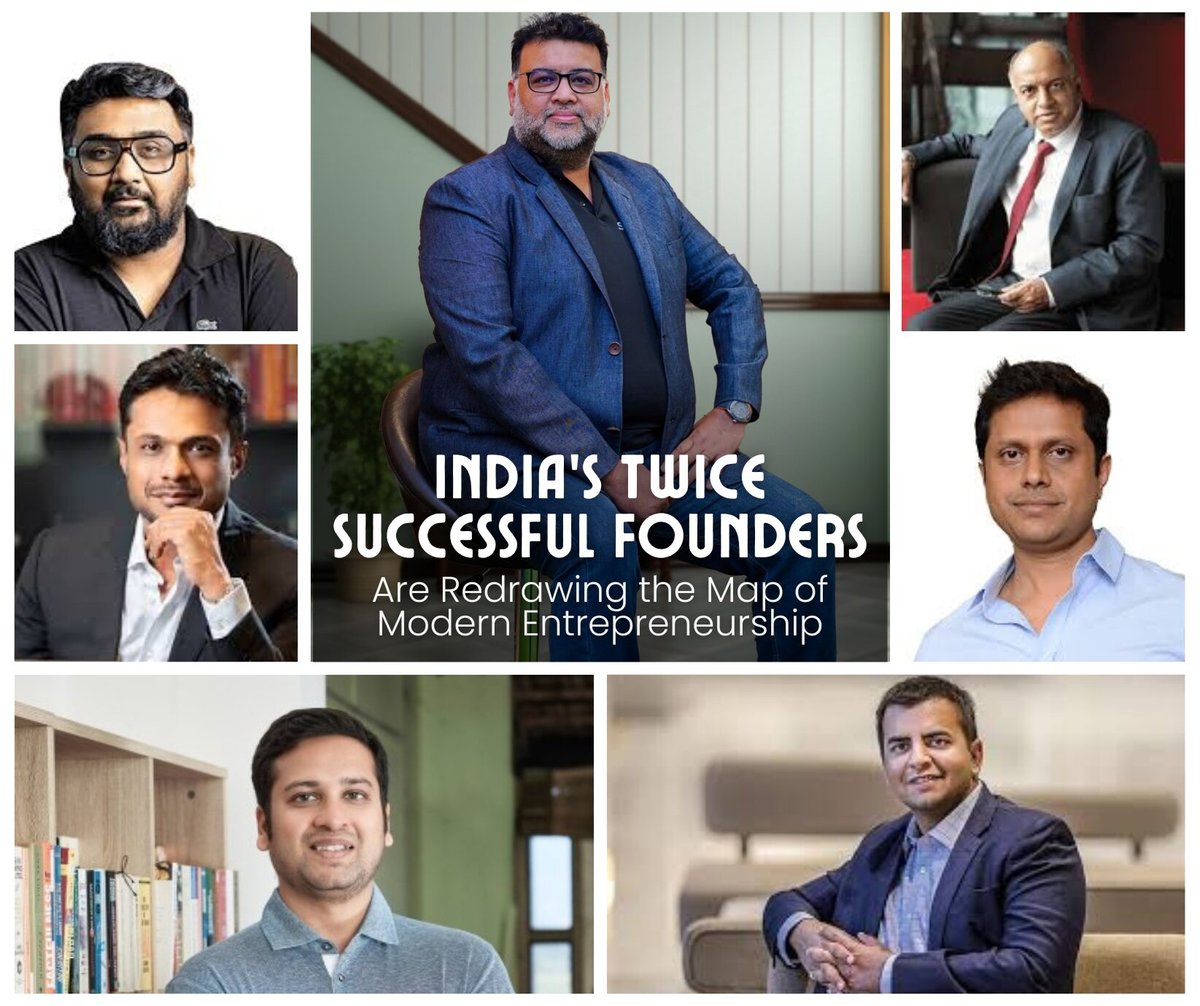
Seven Indian Founders Redefining Success With Their Second Unicorn‑Scale Ventures
India’s startup ecosystem has entered a new era; one where the country’s most accomplished founders are returning for a second innings, not to repeat past victories but to solve deeper, more complex problems. These are not comeback stories. They are evolution stories.
From e‑commerce to AI, from fintech to fresh commerce, these seven founders are proving that the most transformative companies often emerge after the first exit. Their journeys signal a shift in Indian entrepreneurship: from building a company to building a lifelong vocation in innovation.
1. Anant Goel: From Daily Delivery to Reinventing Fresh Produce
First Act: Milkbasket – acquired by Reliance Retail
Second Act: Handpickd – India’s first zero‑stock fresh produce platform
Anant Goel reshaped how urban India buys daily essentials with Milkbasket’s micro‑delivery model. But his second venture, Handpickd, tackles a deeper challenge: trust and quality in fresh produce.
Handpickd operates with zero inventory and zero dark stores, eliminating wastage and ensuring produce never sits in storage. Its “match‑making” model lets customers choose exact ripeness, size, and quality; a level of personalization unheard of in grocery commerce.
With $15M in recent funding, Handpickd is redefining fresh commerce by solving for quality, not just convenience.
2. Kunal Shah: From Democratizing Payments to Rewarding Financial Discipline
First Act: FreeCharge – acquired by Snapdeal
Second Act: CRED – premium financial ecosystem for India’s most creditworthy users
Kunal Shah’s second innings is a contrarian bet: instead of chasing the mass market, CRED focuses on India’s top credit segment. By turning responsible financial behavior into a rewarding lifestyle, CRED has built a premium ecosystem spanning payments, lending, travel, vehicles, and wealth tools.
CRED’s defensible niche; trust, aspiration, and habit reflects the confidence and clarity only a second‑time founder brings.
3. Sanjeev Bikhchandani: From Building Naukri to Building India’s Startup Generation
First Act: Naukri.com
Second Act: Info Edge’s investment portfolio – Zomato, Policybazaar, 99acres, Shiksha
Sanjeev Bikhchandani’s second act isn’t a company – it’s an ecosystem. Through Info Edge, he has backed India’s most iconic internet businesses, offering patient capital and long‑term mentorship.
His approach has created a multiplier effect: founders he backed are now shaping India’s digital economy. This is ecosystem building at national scale.
4. Binny Bansal: From India’s E‑Commerce Revolution to Global Brand Enablement
First Act: Flipkart – acquired by Walmart for $16B
Second Act: OppDoor – enabling Indian brands to scale globally
Binny Bansal’s second innings is quieter but deeply strategic. OppDoor helps Indian D2C brands expand into the US and Europe by handling cataloging, logistics, compliance, warehousing, and marketplace integrations.
It’s infrastructure‑driven, long‑term, and focused on making Indian brands globally competitive – a natural evolution from building India’s largest e‑commerce company.
5. Mukesh Bansal: From Fashion E‑Commerce to India’s Fitness & Wellness Movement
First Act: Myntra
Second Act: Cult.fit – integrated health and wellness ecosystem
Mukesh Bansal shifted from fashion to fitness with Cult.fit, creating a hybrid ecosystem of gyms, digital workouts, mental health services, and preventive care.
Cult.fit’s tech‑enabled, community‑driven model has consolidated a fragmented industry and expanded aggressively post‑pandemic. Mukesh’s second act shows how consumer behavior insights can be transferred across industries to build habit‑forming brands.
6. Bhavish Aggarwal: From Mobility to India’s AI Sovereignty
First Act: Ola
Second Act: Krutrim – India’s first full‑stack AI ecosystem
Bhavish Aggarwal’s second innings is arguably India’s boldest. Krutrim is building foundational AI models, indigenous AI chips, cloud infrastructure, and consumer AI tools – all aimed at ensuring India’s technological independence.
With its first LLM for Indian languages and progress on AI hardware, Krutrim is positioning itself as a national‑scale deeptech platform.
7. Sachin Bansal: From E‑Commerce Giant to Democratizing Finance
First Act: Flipkart
Second Act: Navi – affordable, accessible financial products
Sachin Bansal’s second venture, Navi, builds financial products in‑house – loans, insurance, investments – with a low‑cost, tech‑first approach. Navi’s rapid lending growth, insurance expansion, and banking license ambitions reflect a long‑term institutional vision.
His shift from e‑commerce to fintech shows how second‑time founders tackle foundational problems with clarity and discipline.
The Pattern Behind India’s Second‑Act Founders
What unites these seven leaders?
- They’re solving harder, deeper problems
- They’re building infrastructure, not just apps
- They’re playing long‑term, infinite games
- They’re leveraging experience, not just capital
India’s startup ecosystem is maturing into a landscape where founders build multiple transformational companies over their careers. These seven entrepreneurs are showing what that future looks like.