

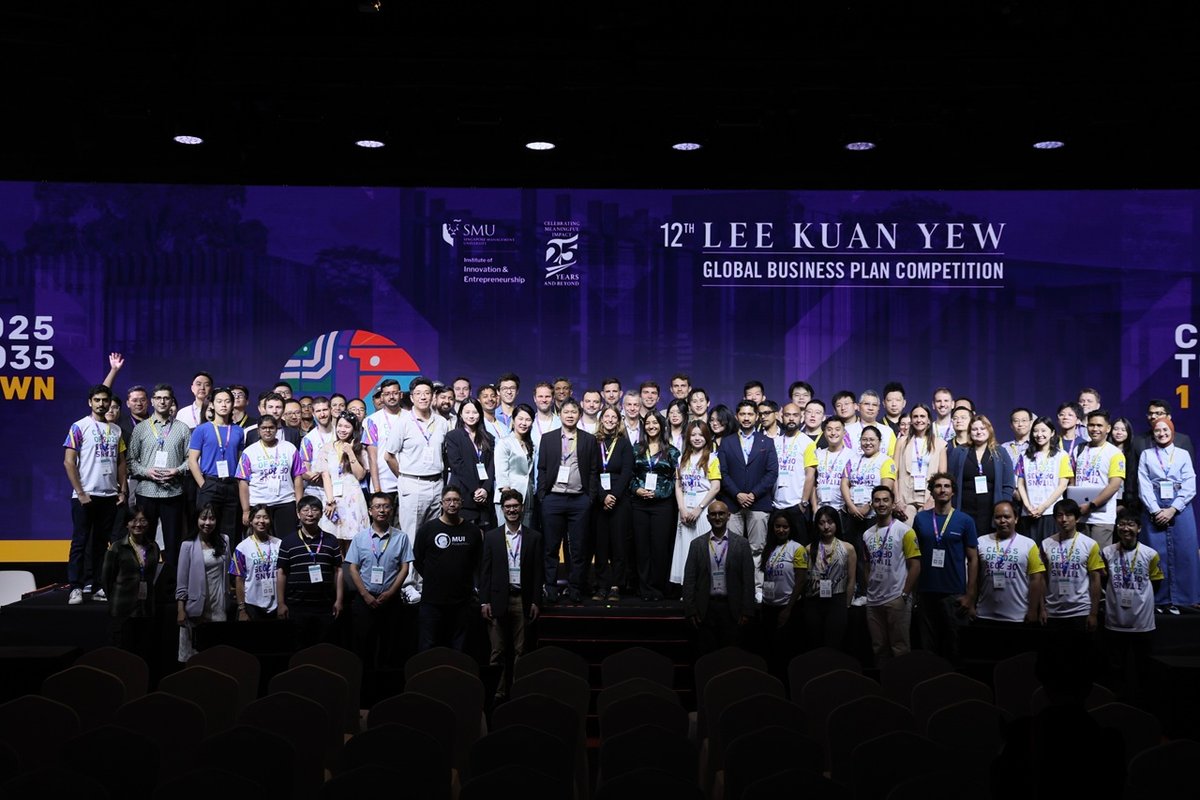
India, October 29, 2026: The 13th Lee Kuan Yew Global Business Plan Competition (LKYGBPC) has opened applications for university founders and recent graduates building solutions in deep-tech, urban innovation, and sustainability sectors.
Organised by the Singapore Management University Institute of Innovation & Entrepreneurship (SMU IIE), the competition is widely regarded as one of Asia’s most globally representative deep-tech startup platforms. The programme focuses on helping founders move beyond technology development and gain access to customers, pilot opportunities, investors, and strategic partners needed to commercialise innovation at scale.
The competition spans 12 focus areas, including:
- Climate Tech
- Energy
- Food and Land Use
- Urban Mobility
- Longevity
- HealthTech
- Sustainable Materials
- Circular Economy Solutions
- Other deep-tech innovation sectors
Over S$2.5 Million in Prizes and Global Exposure
Fifty finalists will be flown to Singapore from 28 September to 1 October 2027 to participate in the competition’s final stage.
Selected finalists will:
- Compete for over S$2.5 million (approximately US$2 million) in prizes
- Participate in an Innovation Festival
- Engage with global investors
- Receive mentorship from industry experts
- Connect with corporate partners and startup ecosystem stakeholders
The programme is designed not only as a competition but as a launchpad for startups seeking market access and commercial validation.
Beyond the Competition: Access to the Urban SustaInnovator Accelerator
Selected finalists will also have an opportunity to join Urban SustaInnovator (USI), SMU’s accelerator programme launched in 2025.
The accelerator supports startups through:
- Market access opportunities
- Pilot project deployment
- Strategic business introductions
- Regional ecosystem access
- Commercialisation support
In May 2026, SMU IIE launched the USI Fund, a dedicated investment vehicle designed to support promising ventures as they pilot, validate, and scale their businesses across Asia.
Building Pathways from Innovation to Market Adoption
Rony Palathinkal, Head of LKYGBPC and Urban SustaInnovator at SMU IIE, said: “Founders of breakthrough technologies can create value only when they reach the people, industries, and communities they are designed to serve. SMU created LKYGBPC as a platform to help founders bring their innovative ideas to life by connecting them with the partners, markets and opportunities needed to turn innovation into real-world impact. Now, through the USI programme and USI Fund, we offer a post-competition pathway to pilot, scale, and raise capital throughout Asia.”
Leveraging Asia-Wide Networks
A major challenge for many sustainability and deep-tech startups is securing access to the right partners and deployment opportunities.
SMU supports founders through its network of Overseas Centres located in:
- Bangkok
- Jakarta
- Ho Chi Minh City
- Shenzhen
The university also maintains International Advisory Councils across eight countries.
Professor Sun Sun Lim, Vice President of Partnerships and Engagement at SMU and Lee Kong Chian Professor of Communication & Technology, said: “SMU’s expansive network of partners from industry, government and community across Asia enables us to forge connections that enable startups to cross borders and scale their innovative solutions.”
Success Story: Standard Physics
One example of the ecosystem’s impact is Standard Physics (formerly Inviscid AI), founded by Qiu Ziming and Kabir Jain.
The startup was a finalist in the 12th edition of LKYGBPC before joining:
- Y Combinator’s Winter 2026 cohort
- SMU’s Urban SustaInnovator accelerator
The company uses:
- Physics-informed AI
- IoT-powered digital twins
to improve energy efficiency in buildings and data centres.
Through the USI programme, the startup secured a pilot project with The GEAR by Kajima, the innovation arm of Japanese construction major Kajima, and is currently evaluating three additional opportunities.
The company has also raised US$2.3 million in seed funding, led by Square Peg Capital, and is preparing to launch an AI-powered agentic engineering platform.
Commenting on the accelerator experience, Kabir Jain said:
“The accelerators were very complementary. YC was good at getting us from zero to one, and then USI has been very helpful in getting us from one to 10. The USI team can make the right introductions and help you grow.”
Singapore Strengthens Sustainability Innovation Ecosystem
Singapore continues to strengthen its position as a global sustainability and innovation hub, providing a supportive environment for startups seeking to pilot and scale solutions.
Key initiatives include:
- The S$37 billion Research, Innovation and Enterprise (RIE) 2030 Plan
- S$10.8 billion allocated for mission-oriented research
- The S$40 million Urban Solutions & Sustainability (USS) Translation Fund
These programmes aim to support the commercialisation and deployment of urban and sustainability innovations.
Building a Global Pipeline of Founders
Established by SMU in 2002, the Lee Kuan Yew Global Business Plan Competition is a biennial programme open to startups with:
- At least one founder currently enrolled in a university programme, or
- A founder who graduated within the last five years
The competition’s 12th edition, held in October 2025, attracted:
- More than 1,500 startup applications
- Participants from 1,200 universities
- Startups representing 91 countries
Notably, finalists from the 9th to 12th editions have collectively raised more than S$1 billion.
Shirley Wong, Entrepreneur-in-Residence at SMU IIE, Chairperson of the 13th LKYGBPC Advisory Committee and Managing Partner of TNF Ventures, said: “As Asia continues to urbanise, the region presents both complex challenges and significant opportunities for innovation. LKYGBPC brings together founders worldwide and connects them with Singapore’s ecosystem of industry, investors and institutions to accelerate solutions with regional and global impact.”
Applications for the 13th Lee Kuan Yew Global Business Plan Competition are currently open and will close on 31 March 2027.


