

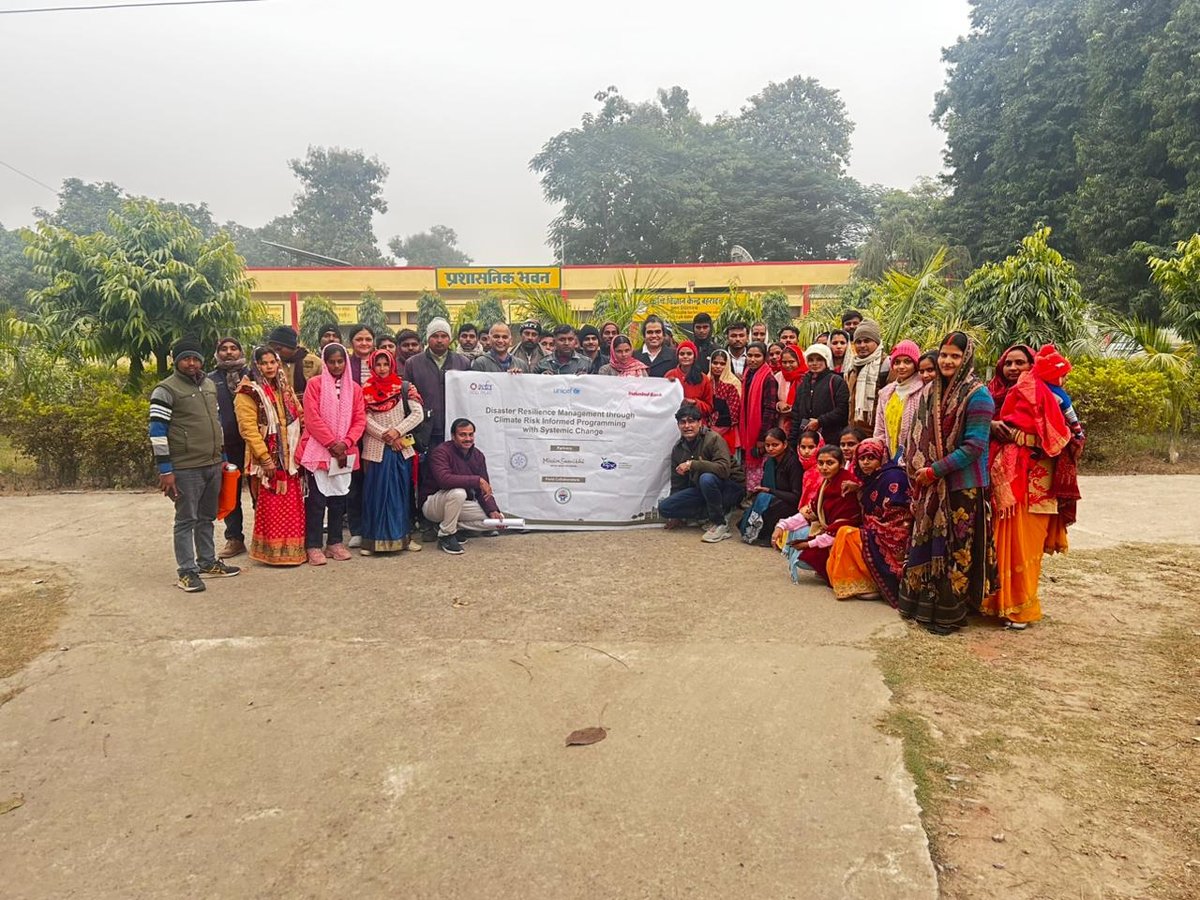
National | June 11, 2026: Resilience AI, an enterprise-tech startup focused on climate resilience, in collaboration with UNICEF and RedR India under the UN 75 Village Development Project, has successfully completed the deployment of AI-supported disaster management plans across 75 Gram Panchayats in Uttar Pradesh, Bihar, and Tamil Nadu.
Funded by the United Nations and UNICEF, the programme explored how Artificial Intelligence (AI) and Machine Learning (ML) can support climate adaptation and disaster management at the intersection of development planning, sectoral priorities, and community needs.
Programme Highlights
- Implemented across Bahraich (Uttar Pradesh), Begusarai (Bihar), and Virudhunagar (Tamil Nadu) — regions exposed to floods, heat stress, and earthquakes.
- Deployment of Resilience360™, a digital web-based platform integrating climatic, geological, ecological, and built-environment data to generate hyperlocal risk profiles.
- Developed Gram Panchayat Disaster Management Plans (GPDMPs) aligned with NDMA guidelines, including:
- Multi-hazard risk and vulnerability assessments (HRVA).
- Risk reduction measures.
- Preparedness interventions.
- Response and recovery strategies.
- Integration with Gram Panchayat Development Plans (GPDPs).
Sarbjit Singh Sahota, Chief DRR a.i., UNICEF: “Today’s polycrisis is not neutral or natural. It’s the result of systemic risk. AI/ML can help decision-makers comprehend problems in their wider context. Resilience AI embraced the reality that risk-resilience is not a finite destination, but an endless game.”
Samhita R, Founding CEO, Resilience AI: “Climate hazards are experienced locally, but tools to understand them are rarely available at the local level. Through this programme, we translated scientific data into practical planning for Gram Panchayats, ensuring climate risk information could be integrated into community-level decision-making.”
Community Validation
- In Tamil Nadu, the platform identified a girls’ school vulnerable to heat stress — validated by community representatives.
- In Bihar and Uttar Pradesh, flood-prone households flagged by the system were corroborated through local feedback.
Impact
- Digital disaster management plans include hyperlocal risk assessments, preparedness and mitigation measures, response and recovery strategies, and digitally mapped action plans linked to governance processes.
- The initiative demonstrates how technology can aid local governance systems through:
- Scientific evidence made explainable.
- Accelerated local decisions based on dynamic intelligence.
- Community participation at scale.
About Resilience AI
Resilience AI is an enterprise-tech startup enabling organizations and governments to assess, manage, and reduce losses from climate hazards through AI/ML-led modelling and simulation.
- Built in response to systemic gaps exposed by Cyclone Yaas.
- Replaces static spreadsheets with real-time, decision-ready systems.
- Resilience360™ delivers:
- Asset-level risk intelligence within 24 hours.
- Organization-level audit and compliance readiness within 72 hours.
- Aligned with Sendai, ESG, and TCFD frameworks.
- Endorsed by NDMA, Government of India.
- Recognized by MeitY (AI for All Global), Google for Startups, KPMG Launch Chapel Hill, RiOT Accelerator (North Carolina), Accenture Open Innovation, Shell Changemakers, Lowe’s Catalyze, and UN-Habitat’s Innovate4Cities.
🌐 Website: https://resilience360.ai
 L&T Finance’s Pitch Point Launchpad for AI Start-ups: Past winners Arrowhead AI and SpoofSense Share Success Stories Ahead of the Second Edition
 India’s Festive Season Business Report 2026: How MSMEs are Preparing for the Diwali Demand Surge
 Keralam Home Minister Seeks Faster Interstate Action Against Drug Networks, Proposes Home Ministers’ Conference