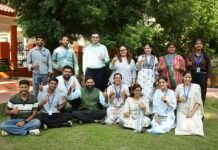
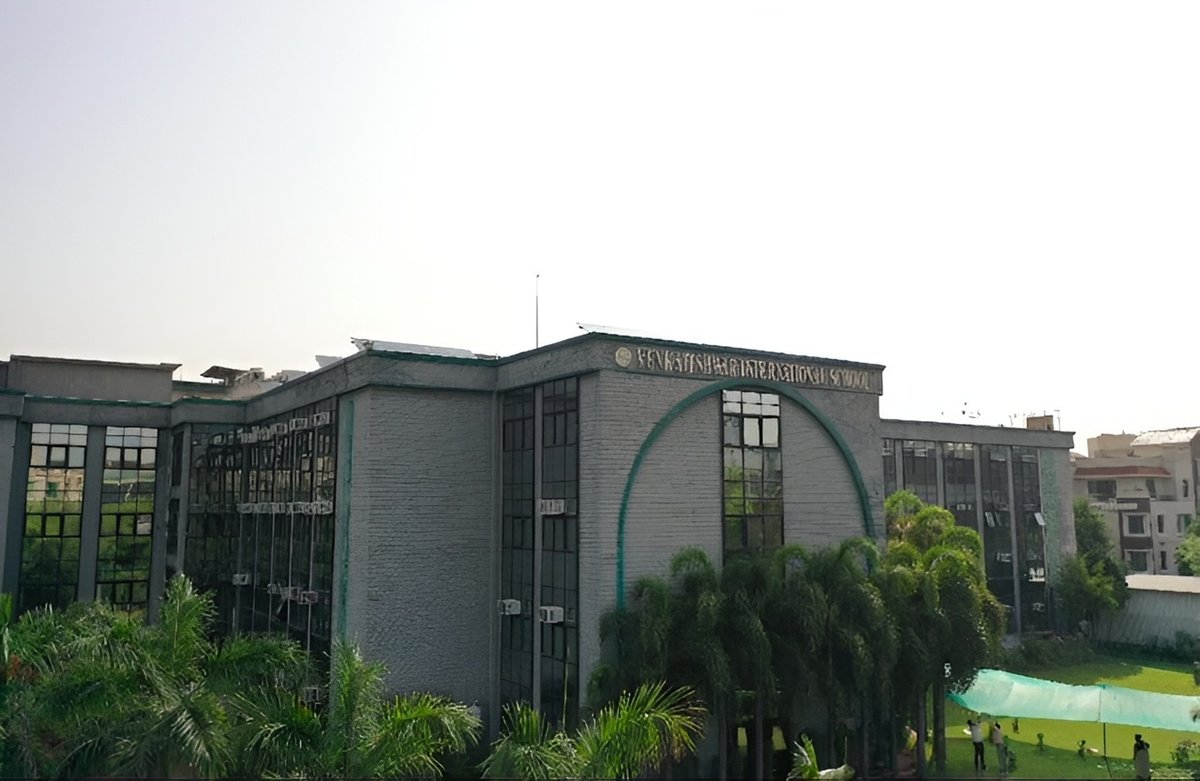
On the last Friday of every month, something unusual happens at Venkateshwar International School in Delhi. Classes don’t follow the usual rhythm. Instead, students pause. They look back at the month that just passed, what they learned, where they struggled, what they want to do differently. It’s called Reflection Day, and in many ways, it captures everything that makes VIS different from a conventional school.
Most institutions measure success by what students produce. VIS is equally interested in whether students understand how they’re growing, and why that matters.
Founded in 2001 by Chairman Shri Mahavir Goel, Venkateshwar International School was built on a conviction that schooling needed to do more than prepare students for examinations. Over two decades later, that conviction has deepened into a full educational philosophy, one that places learner agency, character, global exposure, and community responsibility at the centre of everything the school does.
A Vision That Has Grown With the Times
The founding vision at VIS was clear from the start: academic excellence anchored in strong values, discipline, and a progressive mindset. But what has evolved over the years is the school’s understanding of what “future-ready” actually means.
It no longer simply means strong board results or university placements, though VIS delivers on both. It means graduating students who can think critically, adapt to change, lead with empathy, and engage meaningfully with a world that looks nothing like the one their parents entered. The school describes this as extrapowerment, giving students genuine voice, choice, and ownership of their learning journey. Through student-led councils and structured leadership platforms, students at VIS don’t just participate in school life. They help shape it.
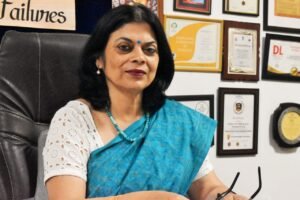
“Our core purpose remains unchanged,” says Shri Mahavir Goel. “To empower students to become ethical, confident, and future-ready individuals.”
Learning That Goes Beyond the Textbook
Walk through VIS and the evidence of this philosophy is everywhere. Innovation platforms like Anveshika give students the opportunity to develop and present original projects, competing at state and national levels, articulating ideas to real audiences, and connecting classroom learning to real-world problems. Students are encouraged to approach subjects with both scientific rigour and artistic curiosity, building the kind of interdisciplinary thinking that modern careers demand.
Global exposure is woven into the fabric of student life, not treated as an occasional add-on. The school maintains active exchange programmes and international delegations with countries including the Netherlands, Finland, Spain, Japan, Australia, South Korea, Singapore, and Sri Lanka. These aren’t just cultural field trips, they’re structured opportunities for students to encounter different educational traditions, build cross-cultural fluency, and return with a broader perspective on their own learning.
At the same time, the school remains deeply rooted in Indian ethos. The international outlook and the local identity aren’t in tension at VIS. They reinforce each other.
Students Who Prove the Model Works
The success stories coming out of VIS span disciplines in a way that reflects a school genuinely invested in the whole student, not just the academic one.
Adhiraj Venkatesh, studying in Class IX, competed against over 200 schools at the state level and earned selection for the National Level Exhibition and Project Competition under the MANAK initiative by the Department of Science and Technology, a testament to the school’s culture of inquiry-driven learning. In sport, the achievements are equally impressive. Manhar Dutta won a Silver Medal at the National School Games organised by the School Games Federation of India in the Under-14 Boys category. Sanvi brought home a Gold Medal in the U-14 10m Peep Rifle category at the 69th National SGFI Games in Bhopal, representing the CBSE Shooting Team.
These individual achievements sit alongside team victories, five VIS students representing Zone 21 claimed third place at the Football Inter-Zonal State Games, and the school’s sporting culture has been significantly shaped by the mentorship of Mr. Devdutt Baghel, a BCCI-level coach and VIS sports mentor who was honoured with the Bharat Ratna Dr. APJ Abdul Kalam Power for India Award for his contribution to sport.
But Shri Mahavir Goel is careful about how he frames these achievements. “These stories are not isolated achievements,” he notes. “They represent a culture where students are encouraged to explore their passions, aim high, and persevere with purpose.”
The Faculty Behind the Students
None of this happens without educators who are themselves committed to continuous growth. VIS invests deliberately in teacher development, through structured training programmes, peer-learning communities, workshops, and exposure to evolving pedagogical practices. Faculty aren’t simply instructed to teach differently. They’re given the space, trust, and support to experiment, reflect, and refine their practice alongside their students.
The school’s leadership philosophy mirrors its student philosophy: collaborative, reflective, and focused on growth rather than compliance. Leaders engage educators as co-creators of the academic journey, not just implementers of curriculum. Regular academic reviews and reflective planning sessions keep innovation purposeful and learner-centred rather than trend-driven.
The result is an institution where the growth mindset the school teaches its students is genuinely modelled by the adults around them.
Community as a Classroom
Education at VIS doesn’t stop at the school gate. Students participate actively in sustainability initiatives, donation drives in partnership with NGOs, and visits to old age homes, structured experiences designed to build empathy, civic awareness, and a felt sense of responsibility to the community beyond the campus.
This isn’t box-ticking. It’s a deliberate extension of the school’s belief that character is built through action, not just instruction. A student who has sat with elderly residents of a care home, listened to their stories, and contributed meaningfully to their day has learned something that no examination can test, and that no career will be complete without.
The Road Ahead
Looking at the next three to five years, VIS has an ambitious but grounded strategic agenda. The priorities include expanding competency-based and personalised learning, deepening innovation and research platforms, building structured pathways in arts, sports, and entrepreneurship, and strengthening the school’s technology-enabled learning environment. Emotional well-being and inclusive practices are explicitly named as strategic priorities, a reflection of how seriously the school takes the whole student, not just the academic one.
Underpinning all of it is a vision of education as a transformative journey rather than a fixed destination. What VIS is building – patiently, deliberately, over more than two decades, is a community of learners who are academically prepared, personally grounded, globally aware, and genuinely ready to contribute to the world they’re inheriting.
That monthly pause for reflection turns out to be more than a nice practice. It’s a philosophy made visible, a school that believes the most important question isn’t just what you’ve achieved, but who you’re becoming.