
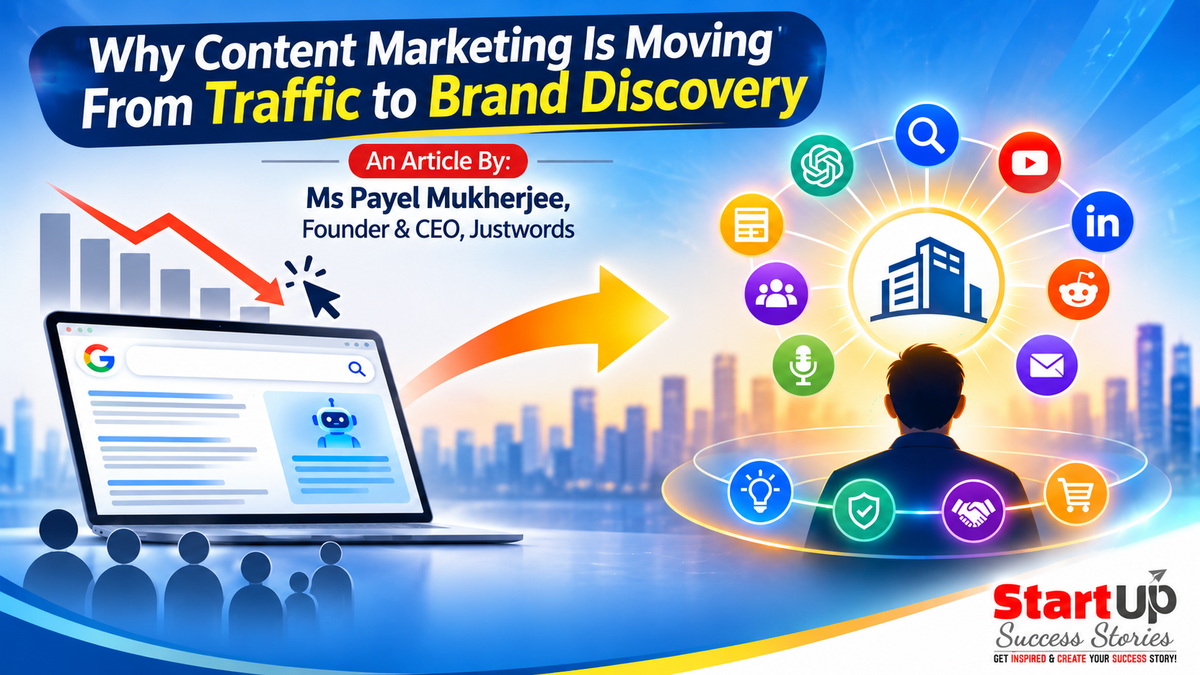
An Article By: Ms Payel Mukherjee, Founder & CEO, Justwords
Talk to the marketing teams of any business, and they will tell you more or less the same story: organic traffic has been falling over the past one or two years, and it is not coming back the way it left.
There is, of course, a reason for it. AI Overviews are increasingly capturing visibility for informational queries, the very queries most businesses relied on to earn traffic in the first place. If a reader already has their answer sitting at the top of the search results, there is often little reason to scroll further and click through to a website offering essentially the same information.
So, what went wrong with content marketing?
Nothing.
What changed was the metric we chose to celebrate.
How Traffic Became the Whole Game
For nearly two decades, content marketing operated on a simple idea: publish something useful, target relevant keywords, earn visibility in search, and capture clicks. Once visitors arrived on your website, they entered your marketing funnel. Content’s role was to guide them from awareness to consideration and eventually to purchase.
Traffic became the proxy for success because it represented attention, reach, and opportunity.
That model made perfect sense because of how the buyer’s journey worked. Write a helpful article that answered an informational query, rank well for it, and you could generate a steady stream of visitors. For years, this approach delivered reliable results.
Then AI Overviews fundamentally changed how that traffic-generation model worked.
Why Informational SEO No Longer Guarantees Traffic
To be clear, traffic generation is not over.
You can still rank. You can still produce authoritative content. What is no longer safe to assume is that ranking automatically leads to a visit, and that a visit automatically leads to a prospect entering your funnel.
Many informational queries are now being satisfied directly within AI-generated search experiences. Users increasingly receive answers without ever needing to visit a website. As AI-enhanced search interfaces evolve across Google and other discovery platforms, brands are finding that visibility and traffic are becoming two very different things.
The result is that many websites that built their growth models around top-of-funnel informational content are reporting significant declines in organic clicks, even while maintaining strong rankings.
The lesson is not that content marketing has stopped working.
The lesson is that content is creating value differently.
That is precisely why traffic can no longer be the only goal of content marketing.
Google Search Is No Longer the Only Discovery Channel
Search itself has stopped being a single-channel journey.
A CMO researching a B2B software category might start with a ChatGPT query, land in a Reddit discussion, watch a YouTube comparison video, ask peers in a professional community, receive a recommendation through a newsletter, and only then search for a specific brand on Google.
By the time that person appears in analytics, much of the content that influenced their decision may never appear in traditional attribution reports.
AI assistants, social platforms, creator content, communities, newsletters, podcasts, and review platforms are all active discovery surfaces today.
This shift matters because AI systems increasingly draw signals, references, and citations from many of these same discovery ecosystems.
The brand that appears consistently across these channels is the brand most likely to win mindshare before a purchase decision is even being actively considered.
This has important implications for marketers. An owned-content strategy that focuses solely on a website is no longer enough. Brands increasingly need to be present in the broader conversations shaping opinions, recommendations, and trust.
Businesses Need to Become Recognisable Entities
Strong brands have always enjoyed an advantage: people remember them before they need them.
The same principle now applies even more strongly in an AI-driven environment.
When content includes original insights, proprietary research, unique experiences, expert viewpoints, or distinctive data, it becomes more valuable. It becomes something that cannot easily be replicated. More importantly, it becomes something worth referencing, discussing, and citing.
This is what makes brands discoverable across multiple channels.
Content today influences demand before intent exists.
For example, a genuinely useful thought-leadership article distributed through a respected newsletter, a podcast appearance, an industry community, or a well-followed LinkedIn profile can shape how a buyer thinks long before they begin evaluating vendors.
That influence is often invisible to traditional attribution models.
But it is not invisible to the business outcomes it creates.
The New Content Marketing Framework
The traditional content marketing model looked like this:
Keyword → Article → Search Ranking → Click → Conversion
The emerging model increasingly looks like this:
Useful or Insightful Content → Brand Discovery Across Multiple Surfaces → Recognition → Trust → Consideration → Conversion
This represents a fundamental shift in how content creates value.
The old model focused primarily on capturing existing demand.
The new model focuses on creating familiarity, authority, and preference long before active demand appears.
When potential buyers eventually enter the market, they already know who you are.
Many marketing teams are already seeing evidence of this shift. As they move away from chasing pure informational volume and begin creating content around real buyer situations and distributing it across multiple channels, they often find that lead quality improves.
Traffic numbers may not be as impressive as they were a few years ago.
But conversions often improve because prospects arrive with greater awareness, trust, and confidence.
The Caveat
It is important not to swing too far in the opposite direction.
Traffic is still valuable.
Transactional searches, local searches, product comparisons, and high-intent queries continue to generate clicks and commercial opportunities. Search engines remain powerful discovery channels, and SEO remains a critical discipline.
Similarly, measurement frameworks for AI visibility and brand discovery are still evolving. Tracking brand mentions, AI citations, and influence across fragmented discovery environments remains imperfect.
The point is not that traffic has become irrelevant.
The point is that traffic can no longer be the only metric that matters.
What This Means in Practice
For marketing teams, traditional content strategies need to evolve beyond rankings and page views.
● Create what AI cannot replicate: Invest in original research, proprietary data, expert experience, customer insights, and unique perspectives. These are the assets that create genuine authority.
● Distribute content across discovery surfaces: SEO remains important, particularly for high-intent searches. But brands also need visibility across communities, creator ecosystems, newsletters, podcasts, social platforms, and AI-assisted discovery environments.
● Redefine success metrics: Look beyond sessions and clicks. Branded search demand, direct traffic, share of voice, customer recall, referral patterns, and qualitative feedback often provide stronger signals of long-term influence.
Build for the Moment Before the Search
The most valuable content marketing outcomes increasingly happen before a buyer begins researching solutions.
By the time a prospect starts searching, much of the decision-making process may already be underway.
The brands that shape opinions early, earn trust consistently, and appear across multiple discovery channels are the brands most likely to be remembered when purchase intent finally emerges.
AI has not made content marketing less important.
If anything, it has made it more strategic.
For years, marketers treated content primarily as a tool for capturing existing demand. Increasingly, its role is expanding toward building authority, shaping perception, and creating familiarity long before a search query is entered.
Traffic still matters. Rankings still matter.
But they are no longer the complete story.
The brands that thrive in this new environment will be those that use content to earn visibility across multiple discovery channels, establish credibility through genuine expertise, and remain consistently present wherever buyers are learning, researching, and forming opinions.
Search will continue to evolve.
Authority, trust, and discoverability will remain timeless.