

You’re holding your newborn, or your 5‑year‑old just started school, and a scary thought creeps in: “How am I going to afford their college fees?”
If you think education is expensive now, wait till you see what it can cost in 10-15 years when your child is ready for engineering, medicine, MBA, or even a foreign degree. A decent private B.Tech that costs around ₹15-25 lakhs today in many colleges could easily go to ₹30-60 lakhs or more over the next 10-15 years if fees keep rising at 8-12% annually. For medical, MBA, or foreign education, the numbers are even bigger, today’s ₹50 lakhs-₹1 crore+ MBBS or ₹50 lakhs-₹2 crores foreign degree can move into the ₹1-4 crores zone over the next 15 years depending on college and country.
The math is intimidating, but if you start planning today – not “someday” – you can spread the burden, use compounding in your favour, and avoid depending entirely on loans.
This guide walks you through how to use LIC plans plus investments to build your child’s education fund, with realistic numbers and a balanced view.
The Brutal Truth About Education Costs in India
What Education Costs Today (2026)
Approximate all‑in costs (fees + basic living) for many private/competitive options in 2026:
- B.Tech (good private college, 4 years): Around ₹15-25 lakhs in many private institutes; premier government colleges can be lower but harder to get into.
- MBBS (private): Often ₹50 lakhs to ₹1 crore+ over the full course in many private colleges; management/NRI seats can be significantly higher.
- MBA (top B‑schools like IIM/ISB and similar): Typically ₹20-40 lakhs for a 2‑year program (tuition only; living expenses extra).
- Foreign undergraduate (US/UK/Australia etc.): Broadly ₹50 lakhs to ₹2 crores, depending on country, course, and lifestyle, including tuition and living.
- Foreign master’s: Roughly ₹30 lakhs to ₹1 crore, again depending on destination and program.
These are realistic ranges based on current fee levels; individual colleges can be above or below this band.
What These Could Cost in 10-15 Years
Education inflation in India tends to run higher than general inflation, often in the 8-12% per year range, while general inflation is typically ~4-6%. At 8-12%, fees can double in about 6-9 years.
Using a 10% education inflation assumption:
- A ₹20 lakh B.Tech today in 15 years:
Future cost ≈ 20,00,000 × (1.10)15 ≈ ₹83 lakhs (rounded). - A ₹50 lakh MBBS today in 15 years:
Future cost ≈ 50,00,000 × (1.10)15 ≈ ₹2.1 crores. - A ₹35 lakh MBA in 12 years:
Future cost ≈ 35,00,000 × (1.10)12 ≈ ₹1.1 crores. - A ₹1 crore foreign degree in 15 years:
Future cost ≈ 1,00,00,000 × (1.10)15 ≈ ₹4.2 crores.
You don’t have to fund 100% of this only from LIC; the idea is to combine LIC (safety + cover) with growth assets like equity mutual funds.
Why Use LIC for Education Planning?
LIC’s traditional plans typically target an effective long‑term return in the 5-7% range depending on bonuses, which is lower than what well‑managed equity mutual funds may deliver over long periods but with much more stability.
What LIC can offer you:
- Guaranteed base benefits: Basic Sum Assured and often guaranteed survival benefits are defined in the policy, independent of markets.
- Life cover built‑in: If the life assured dies, the nominee gets the death benefit (Sum Assured on death + bonuses as per plan conditions), protecting the education goal.
- Savings discipline: Regular annual/half‑yearly/quarterly premiums force you to save consistently rather than skipping investments.
- Tax treatment: Eligible premiums qualify for deduction under Section 80C (up to the overall limit), and many policies qualify for Section 10(10D) tax‑free maturity/death benefits if they satisfy conditions like premium not exceeding 10% of Sum Assured and the aggregate premium cap of ₹5 lakhs per year for specified new policies after April 2023.
- Lower volatility: You’re not exposed to daily NAV swings or sharp market falls just before the goal year.
A sensible approach is to use LIC for roughly 40-50% of your target education corpus (the stable, protected base) and equity mutual funds for 50-60% (the growth component), adjusted for your risk profile.
The Best LIC Plans for Child Education (2026)
These are actual LIC products available now that align well with education timelines.
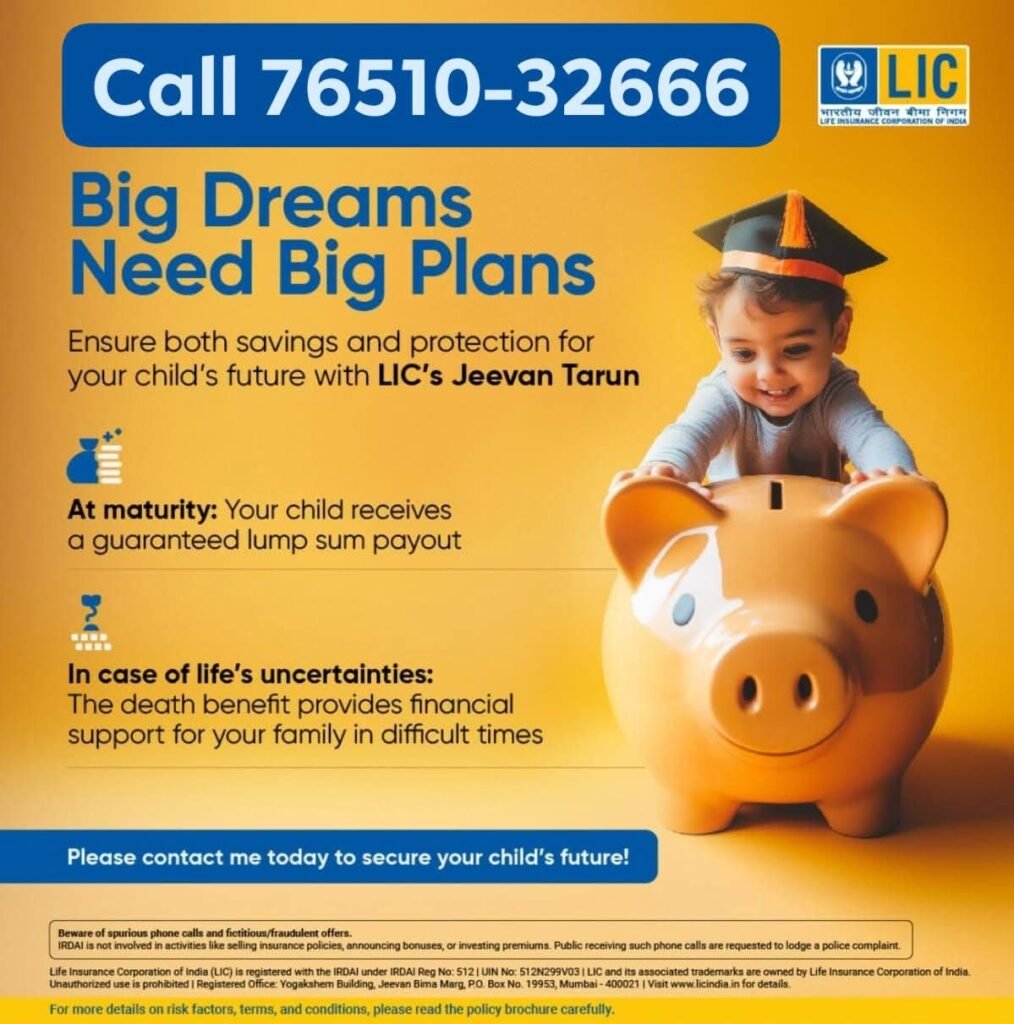
Option 1: LIC Jeevan Tarun – “Perfect Timing” Payouts for College
- Plan No. 834, UIN: 512N299V03.
- Entry age (child): 90 days to 12 years; policy term = 25− entry age; premium‑paying term = 20− entry age.
- Policy always matures when the child turns 25.
Survival benefit options (ages 20-24 vs at 25):
| Option | Payout each year from 20-24 | At age 25 |
|---|---|---|
| 1 | 0% of SA | 100% of SA + Bonus + FAB |
| 2 | 5% of SA | 75% of SA + Bonus + FAB |
| 3 | 10% of SA | 50% of SA + Bonus + FAB |
| 4 | 15% of SA | 25% of SA + Bonus + FAB |
“Real” example (illustrative, not a quote):
- Child age: 3 years, Basic Sum Assured (SA): ₹20 lakhs, Option 3 (10% per year, 50% at maturity).
- Ages 20-24: Each year, 10% of SA = ₹2 lakhs (total 50% = ₹10 lakhs).
- Age 25: Remaining 50% of SA = ₹10 lakhs + vested Simple Reversionary Bonuses + any Final Additional Bonus.
Total benefits can be significantly higher than the SA due to bonuses, but the exact figure (like “₹28-30 lakhs”) depends on future bonus rates, which are not guaranteed and should not be assumed as fixed.
Typical annual premium for such a structure (parent in early/mid‑30s, SA ₹20L, child age 3) is often in the ₹45,000-55,000 per year band based on public illustrations, but must always be confirmed from official LIC quotes.
Who it suits: Parents who want structured payouts during college years plus a maturity amount.
Option 2: LIC New Children’s Money Back Plan – Milestone‑Based Payouts
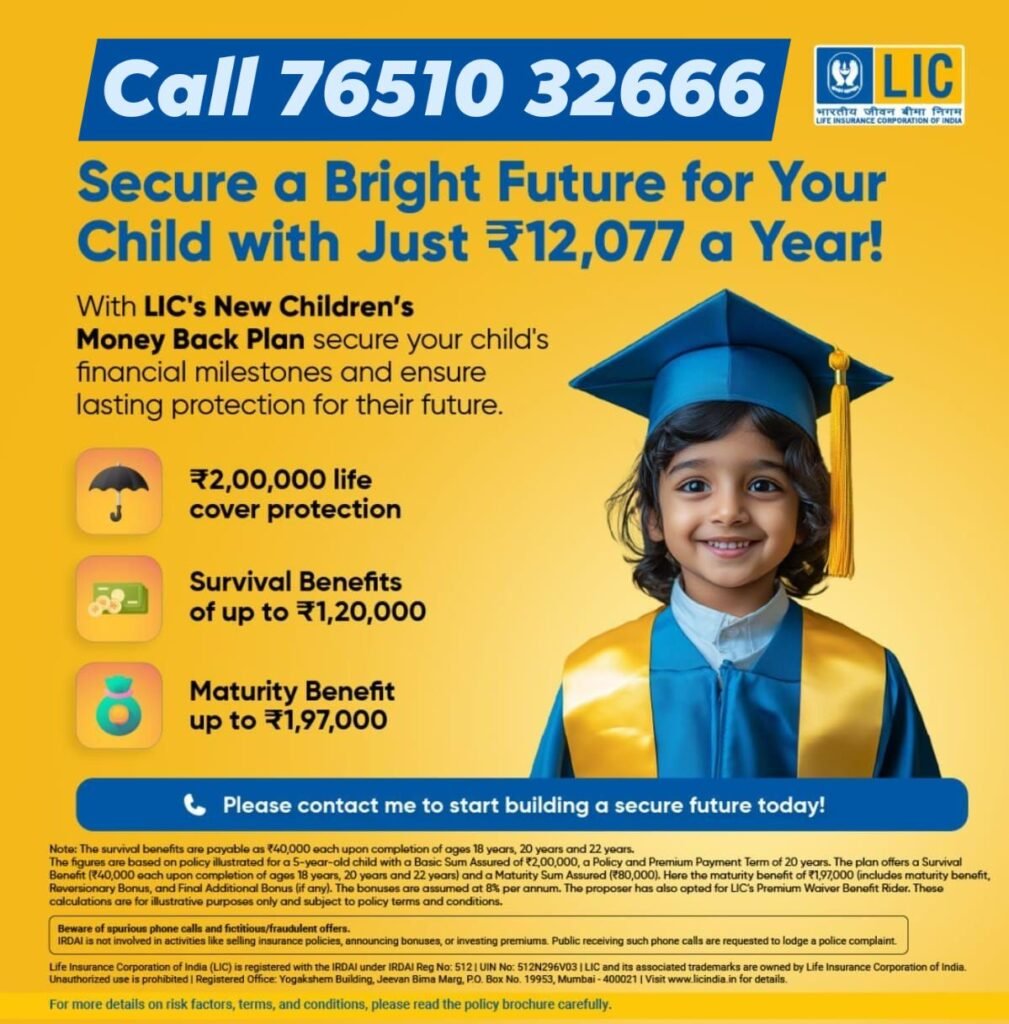
- At age 18: 20% of Basic SA
- At age 20: 20% of Basic SA
- At age 22: 20% of Basic SA
- At age 25: 40% of Basic SA + vested bonuses + Final Additional Bonus (if any)
Illustrative example (not a quote):
- Child age 5, Basic SA ₹15 lakhs.
- Age 18: ₹3 lakhs
- Age 20: ₹3 lakhs
- Age 22: ₹3 lakhs
- Age 25: ₹6 lakhs + bonuses (e.g., if bonuses total around ₹5 lakhs, maturity ≈ ₹11 lakhs).
Total benefits could be around ₹20 lakhs on a ₹15L SA in such an illustration, but exact amounts depend entirely on bonus declarations and official benefit illustration.
Annual premium for ₹15L SA for a young child is typically in the ₹35,000-45,000 per year zone in many illustrations, but exact premiums vary by age, mode, and riders.
Who it suits: Parents who prefer bigger lumps at ages 18, 20, 22, and 25 instead of every‑year payouts.
Option 3: LIC New Jeevan Anand – One Big Lump Sum + Lifelong Cover
- Plan No. 915.
- Traditional endowment plan with maturity at end of term and continued life cover thereafter.
- Policy term: Generally 15-35 years; after term, premiums stop and maturity is paid.
- Maturity = Basic SA + Simple Reversionary Bonus + Final Additional Bonus, if any.
- Life cover equal to Basic SA continues after maturity for the rest of the life assured’s lifetime.
Illustrative use case:
- Parent takes New Jeevan Anand when child is 0-3 and chooses a 15-20 year term so that maturity coincides with college start (18-20 years).
- For SA ₹25 lakhs and a suitable term, maturity could be ₹25 lakhs + bonuses, which in many sample illustrations can reach ₹35-45 lakhs, but this depends on future bonus rates.
Annual premium for SA ₹25L with 15-20‑year term is often in the ₹55,000-70,000 range in public calculators (age‑ and term‑dependent).
Who it suits: Parents wanting one large lump sum at the start of higher education plus long‑term life cover.

Option 4: LIC Jeevan Umang – Lifetime Income That Can Fund Education
- Revised Plan No. 945.
- Participating whole‑life plan with coverage up to age 100.
- Premium‑paying term: 15, 20, 25, or 30 years.
- After the PPT, policy pays 8% of Basic SA every year as guaranteed annual survival benefit until death or maturity, plus bonuses at maturity or on death.
Education strategy:
- Start early on parent or child’s life; align end of PPT just before college years.
- Example (conceptual): SA ₹30 lakhs, PPT 18-20 years. After PPT, the policy can pay 8% of SA = ₹2.4 lakhs per year, which can help with recurring tuition and living costs for several years.
Who it suits: Families who prefer ongoing annual cash flow rather than a single lump sum.

Option 5: LIC Jeevan Utsav – Flexible Income with Whole‑Life Cover
- Plan No. 871, UIN: 512N363V02.
- Non‑linked, participating, whole‑life plan with limited premium payment (about 5-16 years) and options for regular income or accumulation and flexible withdrawals after the benefit start date.
- Continues life cover and participation in bonuses; multiple riders may be attached.
Who it suits: Parents who want greater control over when and how to draw income, including for education, while keeping long‑term cover intact.

How Much Sum Assured Do You Actually Need?
Step 1: Estimate Future Cost
Use:
Future Cost ≈ Present Cost × (1+i)n, where i is education inflation (say 10%) and n is years to goal.
Examples:
- B.Tech: Present cost ₹20 lakhs, child age 3, goal 15 years away:
Future ≈ ₹83.6 lakhs. - MBBS: Present cost ₹60 lakhs, child age 5, goal 13 years away:
Future ≈ 60,00,000 × (1.10)13 ≈ ₹2.1 crores. - Foreign master’s: Present cost ₹40 lakhs, goal 14 years away:
Future ≈ 40,00,000 × (1.10)14 ≈ ₹1.5 crores.
Step 2: Decide the LIC vs Other Investments Split
A balanced illustration:
- 40-50% from LIC plans (stable, with life cover).
- 50-60% from equity mutual funds (growth to beat inflation).
For a target of ₹80 lakhs in 15 years:
- LIC target: approx ₹35-40 lakhs.
- Equity target: approx ₹40-45 lakhs.
Step 3: Work Backwards to Sum Assured
Very approximate rules of thumb based on typical illustrations:
- Jeevan Tarun: SA ₹20 lakhs might yield total benefits in the ₹28-35 lakhs band over survival benefits + maturity (depending heavily on bonuses).
- New Children’s Money Back: SA ₹15 lakhs often gives combined payouts in the ₹20-25 lakhs zone in many sample illustrations.
- New Jeevan Anand: SA ₹25 lakhs can result in ₹35-45 lakhs maturity including bonuses in some sample projections.
- Jeevan Umang: SA ₹30 lakhs can provide ₹2.4 lakhs per year (8% of SA) as guaranteed survival benefit after PPT; over 6-8 college years, that’s about ₹14-19 lakhs, plus eventual maturity/death benefit.
These are conceptual; always rely on the official benefit illustration for exact numbers.
Step 4: Check Premium Affordability
Indicative yearly premiums (very approximate ranges):
- SA ₹10 lakhs: around ₹25,000-35,000/year.
- SA ₹15 lakhs: around ₹40,000-55,000/year.
- SA ₹20 lakhs: around ₹50,000-70,000/year.
- SA ₹25 lakhs: around ₹60,0008-5,000/year.
Actual premium depends on:
- Your age and health.
- Child’s age (for child‑plans).
- Plan type and term.
- Premium paying term and frequency.
- Riders selected.
A common thumb rule is to keep total education‑planning premiums within 10-15% of your annual income, but this must fit your own cash‑flow and other goals.
Putting It All Together – A Practical Strategy
For a Newborn to 5‑Year‑Old
- Core plan: Jeevan Tarun with SA ₹15-20 lakhs, Option 3 or 4, to fund college years.
- Approx premium: ₹45,000-60,000/year for about 20 years (exact quote needed).
- Alongside: Equity mutual fund SIP of ₹15,000-20,000/month for 18 years could reasonably target ₹1 crore+ at ~12% assumed return (not guaranteed).
Combined, you can aim for a ₹1.2-1.6 crore total corpus for ambitious goals like foreign studies or medical, subject to actual returns and bonuses.
For a 6-10‑Year‑Old
- Core plan: LIC New Children’s Money Back (Plan 932) with SA ₹15 lakhs.
- Approx premium: ₹40,000-50,000/year for 15-18 years.
- Complement: Equity SIP ₹20,000-25,000/month for 12-15 years targeting ~₹60-90 lakhs.
Expected total across LIC + equity could be around ₹80 lakhs-₹1.15 crores in many scenarios.
For an 11-15‑Year‑Old
You have less time, so:
- Option: New Jeevan Anand with a shorter 12-15‑year term and SA ₹20-25 lakhs for a concentrated lump sum.
- Premiums will be higher (e.g., ₹70,000-1,00,000/year range depending on age/term).
- Run a more aggressive equity SIP (e.g., ₹40,000-50,000/month for 5-8 years) and be ready to use education loans to bridge gaps if needed.
Tax Treatment – Quick Snapshot
- Section 80C: Eligible LIC premiums can be claimed within the overall ₹1.5 lakh limit along with PPF, ELSS, home loan principal, etc.
- Section 10(10D): Subject to conditions (like premiums not exceeding 10% of SA; combined premium cap of ₹5 lakhs per year on applicable new policies after 1 April 2023), many LIC policy proceeds continue to be exempt from tax.
- Always verify with a CA because tax rules and thresholds are evolving.
Action Steps
- Use an education inflation calculator to estimate your child’s future education cost.
- Decide a realistic target corpus (add a buffer of 15-20%).
- Fix how much you can comfortably commit as annual LIC premium + monthly SIP.
- Get official LIC benefit illustrations for:
- Jeevan Tarun
- New Children’s Money Back
- New Jeevan Anand
- Jeevan Umang / Jeevan Utsav
- Compare, then choose one or two core LIC plans plus an equity SIP and start immediately rather than waiting for the “perfect time.”
Disclaimer
All premium and benefit figures here are illustrative and approximate, based on typical public illustrations and general assumptions; actual premiums and benefits depend on age, health, plan variant, premium mode, riders, and LIC’s future bonus declarations, which are not guaranteed. Tax benefits depend on current Income Tax laws and your specific eligibility; these can change, so always confirm with a qualified tax professional. This article is for educational purposes only and is not personalised financial advice; please consult a life insurance advisor before purchasing any policy.