

- An article by Achintya Gupta, CEO at Reo.Dev
Developer-centric go-to-market took a decade to mature into something coherent. The insight at its core was straightforward: in a world where teams assemble stacks from dozens of specialized tools rather than buy into a single platform, the developer doing the integration is the one whose trust you need to earn first. That insight produced an entire motion, product-led growth, developer relations, documentation-as-marketing, community-led awareness, all oriented around the premise that a human with technical judgment was the first and most important evaluator in the room. That premise is starting to break because the first evaluator is increasingly a machine.
Engineering teams today operate under a volume of tooling decisions that manual evaluation cannot keep pace with. Requirements shift, architectures evolve, cost constraints tighten, and the catalog of available tools has expanded beyond what any team can assess systematically on its own. The response, increasingly, is delegation, not to junior engineers or vendor committees, but to AI agents given the task of filtering, testing, and recommending. In many cases, the final decision still involves a human stakeholder, but increasingly the evaluation, ranking, and shortlisting work happens through machine-driven assessment long before a person enters the loop. The path to that decision now runs through machine evaluation, and the GTM motion built entirely around human intent signals was not designed to see it.
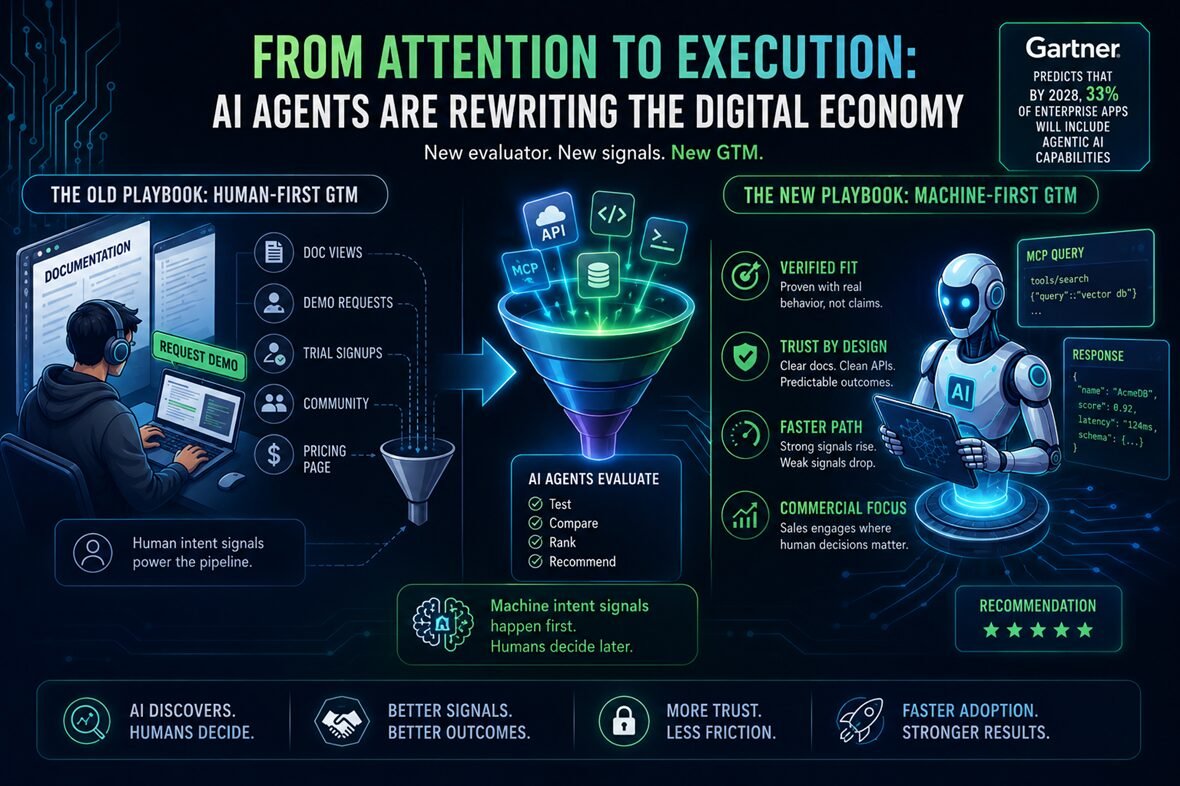
The scale of this shift is already visible in engineering behavior. Gartner predicts that by 2028, 33% of enterprise software applications will include agentic AI capabilities. As AI systems become embedded into operational workflows, they naturally become part of how organizations evaluate software, infrastructure, APIs, and external services. AI has moved beyond productivity assistance into active participation across execution, orchestration, testing, and technical decision-making.
What the Evaluation Actually Looks Like
An agent assigned to find a capability does not browse for inspiration or read testimonials. It queries for proof. It consults available registries, reads schema documentation, calls an endpoint with a test payload, and checks whether the response structure fits the workflow it is building. If the behavior is predictable and the output is clean, integration proceeds. If not, the agent moves to the next candidate without raising an objection, without leaving feedback, and without giving the rejected tool any signal that an evaluation occurred.
What this means practically is that the quality of a product’s API design and the machine-readability of its documentation are now becoming primary evaluation surfaces, alongside the traditional work already done by engineering, product, developer relations, and GTM teams to build trust and adoption. An agent cannot be persuaded by positioning. Claims that cannot be verified against observable behavior are treated as noise. A well-structured MCP server with clear schema and executable documentation gets evaluated on its merits. A poorly documented integration gets dropped in the same timeframe, and no one on the GTM team is informed either way.
Documentation, in this context, stops being a website designed to build confidence in a human reader and starts functioning as an API that a machine queries to determine fit. The product is no longer being described to someone who will form a judgment. It is being interrogated by a system that will return a structured recommendation.
The Intent Signal Exists. The Funnel Cannot Read It
The signals that traditional devtool GTM was built to capture are human signals. Pricing page visits, documentation sequences that suggest active evaluation, trial signups traceable to a company domain, inbound demo requests with a job title attached. These are legible. An entire layer of tooling grew up around scoring them and routing them to sales at the right moment.
Each of those interactions is a tool being actively considered for integration into a workflow, which is precisely what a demo request represents when a human sends one. The difference is that the human lands in a system built to receive them. The agent passes through unseen, and the evaluation, whether it ended in selection or rejection, leaves no trace in any dashboard the GTM team is watching. DevTool companies are being assessed and passed over daily, with no record of either outcome in any system they currently operate.
The Commercial Layer Shifts Upward
As agent-assisted evaluation handles more of the discovery, testing, and early filtering work, the role of sales shifts toward the layers of decision-making that still require institutional accountability and human coordination. A developer who arrives having already run an agent-assisted evaluation against several candidates is not looking for a feature demonstration. They have performance data. They have comparative benchmarks. What they need from a sales conversation is the conversion of that technical proof into something an organization can commit to: enforceable SLAs, documented failure modes, defined rollback paths, answers to the compliance and procurement questions that agents cannot resolve on their own.
Sales, in this model, stops being primarily the function that introduces and explains a product and becomes increasingly the function that removes blockers around adoption. The evaluation work has often already been done upstream through automated testing, peer validation, or internal benchmarking. What stalls adoption is not necessarily lack of product conviction, but unresolved constraints, security requirements, data governance rules, procurement thresholds, and organizational accountability. These require human ownership. They are also the areas where sales and customer success teams remain most strategically valuable.
An agent calling an MCP server and evaluating a tool is expressing intent as clearly as a developer requesting a demo. API call spikes from unidentified clients, documentation crawls, SDK interactions, MCP server evaluations, these are machine intent signals, and they carry the same commercial significance as the human intent signals that current GTM infrastructure was built to track.
The teams adapting earliest to this shift are making their products interpretable to agents through machine-readable capability signals, queryable documentation, and runnable benchmarks, and building the instrumentation to surface agent-led evaluation activity to their GTM teams in real time. The developer go-to-market playbook spent a decade being written around earning developer trust. That work still matters. But the playbook now needs a chapter written for a world where an AI agent is often the first evaluator in the room, and it neither reads landing pages nor raises its hand when it is done.
 15 Electric Mobility Startup Opportunities India Needs Now
 World EV Day 2026: Is Switching to Electric Actually Cheaper for Indian Riders and Businesses?