

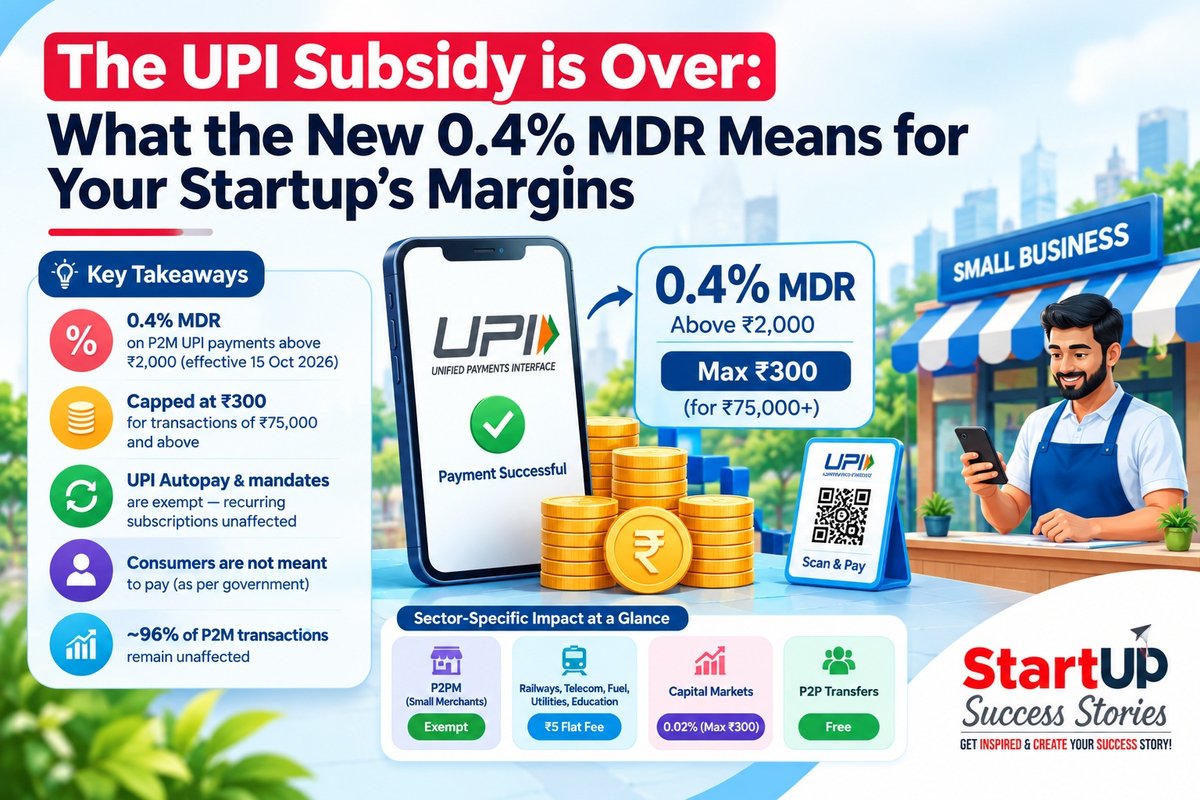
Key takeaways:
- 0.4% MDR applies to Person-to-Merchant UPI payments above ₹2,000, effective 15 October 2026
- Capped at ₹300 for transactions of ₹75,000 and above
- UPI Autopay and mandates are exempt – recurring subscriptions unaffected
- Consumers are not meant to pay – the government has stated this explicitly, and banks have been advised accordingly
- ~96% of P2M transactions remain completely unaffected
For over six years, UPI’s defining pitch to Indian merchants was simple: it was free. That changes on 15 October 2026, when the National Payments Corporation of India’s (NPCI) new Merchant Discount Rate (MDR) framework kicks in – a 0.4% fee on select Person-to-Merchant (P2M) UPI transactions above ₹2,000, as per the government’s official notification and FAQ.
This isn’t the end of “free UPI” for most people – person-to-person transfers stay free, and so do merchant payments under ₹2,000. The government estimates that roughly 96% of P2M transactions will remain entirely unaffected by the new framework. But for any startup processing meaningful volume above ₹2,000, this is a real shift in the cost of doing business, and also a real set of new opportunities. Here’s what founders actually need to know.
The Core Narrative: A More Mature Digital Payments Ecosystem
For years, the zero-MDR model on UPI was subsidised through direct government incentive payouts to banks and payment providers, compensating them for processing P2M UPI transactions at no charge to merchants. That incentive pool has shrunk sharply – from over ₹3,250 crore in FY24 to roughly ₹2,000 crore in FY25, with just over ₹400 crore reportedly set aside for FY26 according to public budget coverage and analyst summaries – even as UPI transaction volumes kept climbing into the billions per month.
It’s worth being precise here: the government has been clear that MDR is not a tax and not revenue collected by the government or NPCI – it’s a fee shared among ecosystem participants (banks, payment service providers, and app providers) to fund infrastructure, cybersecurity, and service costs they’ve been absorbing without compensation. Whether you read the shift as overdue financial sustainability or as the natural cost of scale, the practical upshot is the same: UPI is transitioning from a fully subsidised public good to a more conventional payments rail with a modest, targeted cost built in – similar in spirit to (though far cheaper than) card MDR.
The Financial Impact Blueprint
Here’s exactly what changes, based on the official framework:
- Below ₹2,000 – Exempt: No MDR. The government estimates that roughly 96% of P2M transactions by volume will remain entirely unaffected by the new framework.
- Above ₹2,000 (P2M) – 0.4% Fee: On a ₹10,000 merchant payment, that’s ₹40. On a ₹50,000 payment, ₹200.
- ₹75,000 and above – ₹300 Cap: The fee is capped at a flat ₹300, regardless of transaction size. A ₹1,00,000 payment, which would otherwise carry a ₹400 charge at 0.4%, is capped at ₹300.
- Small merchants (P2PM category) – Exempt: Merchants who receive up to ₹1 lakh per month in their bank account via UPI QR codes – typical kirana stores, street vendors, and small local shops – are exempt from MDR entirely. This threshold-based exemption is designed to shield the smallest merchants from any added cost burden.
- Essential and low-margin sectors – ₹5 Flat Fee: Railways, telecom, insurance, fuel, agricultural inputs, utility bills (electricity, water, piped gas), and education fee payments attract a flat ₹5 fee per transaction above ₹2,000, rather than the 0.4% variable rate. According to government statements as reported in mainstream coverage of the Finance Ministry’s position, these sectors account for around 17% of P2M transaction volume but roughly 46% of transaction value – which is why they receive concessional treatment.
- Capital markets – 0.02% Fee, ₹300 Cap: Payments toward mutual funds, securities, and stockbroking carry a lower rate of 0.02%, capped at ₹300.
- Who pays – Merchant, Not Customer: The MDR is charged to the merchant, not the customer, and person-to-person transfers are unaffected regardless of amount.
Who feels this most: Startups processing high-ticket B2B payments, D2C brands with average order values consistently above ₹2,000, and subscription or service businesses billing customers in that range will see this show up as a real line item. In practice, after accounting for the ₹300 cap on very large payments, the effective MDR burden for most qualifying transactions will land in the 0.3–0.4% range of applicable transaction value – model it as an incremental cost on qualifying P2M volume above ₹2,000 rather than assuming a flat 0.4% across everything you process.
Sector-Specific Impact at a Glance
| Startup Sector | Primary Impact | Tactical Survival Play |
|---|---|---|
| 📦 D2C & E-Commerce (AOV > ₹2,000) | Margin compression of up to 0.4% on high-ticket checkouts. | Consider cart structuring – where it genuinely fits your product mix, pricing tiers under ₹2,000 stay on free UPI rails. Treat this as one lever among several, not a rule to force, and avoid artificially fragmenting orders or creating separate transactions purely to dodge the fee. |
| 💻 B2B SaaS & Enterprise (High-ticket invoices) | Flat cost increase, but insulated by the ₹300 cap on invoices over ₹75,000. | For large enterprise deals, evaluate net banking or eNACH rails alongside UPI to see which is more cost-effective at your typical deal size. |
| 🔄 Consumer Subscription (OTT, EdTech, Fitness) | Zero MDR impact on recurring revenue streams, since UPI mandates and Autopay transactions are explicitly excluded from the new fee. | Prioritise migrating users to UPI Autopay for renewals to keep recurring billing on the fee-free path. |
| 🚀 FinTech & Payments (TPAPs, Neo-banks, PSPs) | Access to a newly unlocked MDR revenue pool shared across ecosystem participants – not collected by the government or NPCI. | Explore direct payment-processing revenue as a complement to existing cross-sell models (loans, insurance, investments). |
On passing the cost to customers: This is more settled than it might first appear. The government has explicitly stated that consumers are not meant to bear the MDR charge, and – per mainstream coverage of Finance Ministry statements – banks have been advised to ensure merchants don’t pass the fee on to customers, with monitoring mechanisms reportedly being discussed to enforce this.
That said, the exact enforcement mechanism and penalty structure have not been spelled out in detail in the public FAQ, so treat any plan to pass this cost to customers as high-risk from both a regulatory and brand-trust perspective. Confirm your specific obligations with your payment aggregator and legal counsel before implementing anything.
Opportunities for Fintech and Payments Startups
For fintech companies, this is arguably a bigger structural shift than it is a cost. MDR is distributed across ecosystem participants – issuing banks, acquiring banks, payment service providers, and Third-Party App Providers (TPAPs) like the UPI apps merchants and consumers actually use. For years, TPAPs processed enormous UPI volume with essentially no path to direct revenue from it. A live MDR pool changes that math meaningfully, and is likely to accelerate monetisation strategies among payment apps that previously relied entirely on cross-selling other financial products to stay viable.
The fraud-tech and compliance opportunity: NPCI has explicitly tied part of the MDR’s purpose to infrastructure resiliency and cybersecurity investment across the UPI ecosystem. For startups building in AI-based fraud detection, secure checkout authentication, and payments compliance tooling, this signals real, funded demand from banks and payment providers over the next few years – not just a nice-to-have pitch angle.
Advanced Tech Trends Worth Tracking Alongside MDR
These developments are shaping where UPI-linked opportunity is heading, independent of the MDR change itself. Treat specific adoption claims cautiously until backed by usage data:
- Credit on UPI: Pre-sanctioned credit lines accessible through UPI rails continue to scale, and subscription-based businesses (SaaS, OTT, D2C) building around UPI Autopay and mandate-based billing stand to benefit from more flexible underlying credit infrastructure, since Autopay mandates are explicitly excluded from the new MDR.
- UPI Tap-and-Pay / NFC: Contactless UPI is a genuine opening for hardware and software startups looking to compete with traditional card-based point-of-sale systems, particularly for high-footfall retail.
- Conversational and voice-based payments: AI-driven, voice-first UPI interfaces are being positioned as a way to extend digital payment adoption into Tier-3 towns and rural markets where typing-heavy interfaces remain a barrier – a space worth watching but still early-stage in India.
Potential Bottlenecks and Survival Strategies
- Rebudget transaction costs into opex. For e-commerce and services startups with meaningful transaction volume above ₹2,000, treat the MDR the same way you’d treat a payment gateway fee – build it explicitly into your unit economics rather than absorbing it as a surprise margin hit after the fact. Model it as an incremental 0.3–0.4% cost on qualifying P2M volume above ₹2,000, with the ₹300 cap reducing the effective rate on very large tickets.
- Watch for alternative routing behaviour. It’s plausible some larger merchants nudge customers toward net banking or co-branded cards for high-ticket payments to manage costs – for example, enterprise SaaS and B2B marketplaces may start comparing UPI vs. net banking vs. card MDR at typical deal sizes before setting default payment options. This is a prediction, not a confirmed trend yet, so worth monitoring rather than assuming.
- Reconcile with your payment aggregator early. Confirm with your PSP or aggregator exactly how the 0.4% MDR, the ₹300 cap, and category-specific rates will be reflected in your settlement statements from 15 October onward. Ask for a sample settlement breakdown showing MDR as a separate line item so reconciliation doesn’t become a finance headache post-launch.
The Bottom Line
The end of fully free UPI for merchants isn’t a crisis – it’s UPI settling into a more sustainable, arguably more investable phase of its life as India’s dominant payments rail. For most small businesses and everyday transactions under ₹2,000, nothing changes, and the government has been clear that consumers are not meant to bear the MDR charge.
For startups operating at the ₹2,000+ ticket size, this is a real, quantifiable cost worth planning for now rather than in October. And for fintech builders, it’s a funded signal that fraud prevention, payments infrastructure, and TPAP monetisation are about to get a lot more investor and enterprise attention.
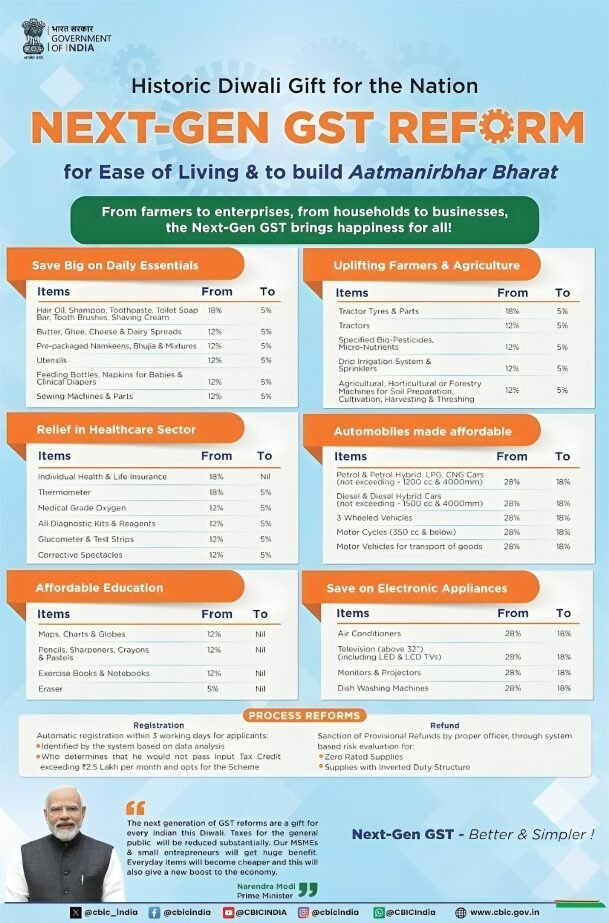 Next Gen GST Reform: India’s Two-Slab Tax Structure Explained
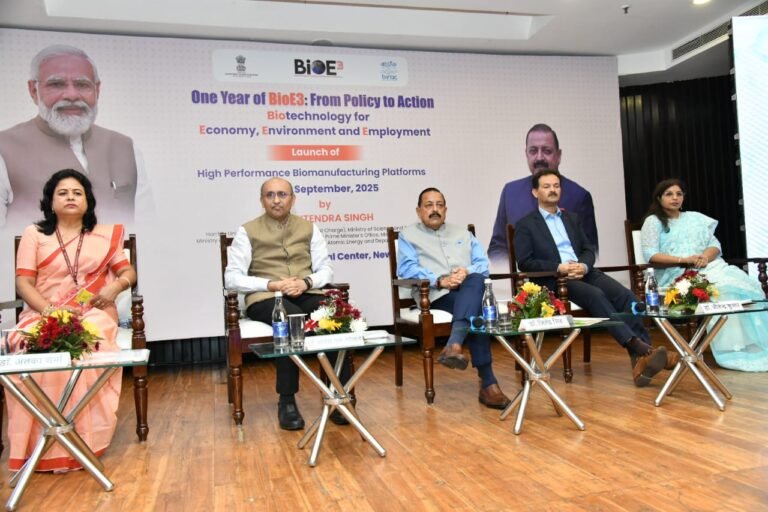 DBT-BIRAC Rolls Out India’s First Biofoundry Network Under BioE3 Policy