

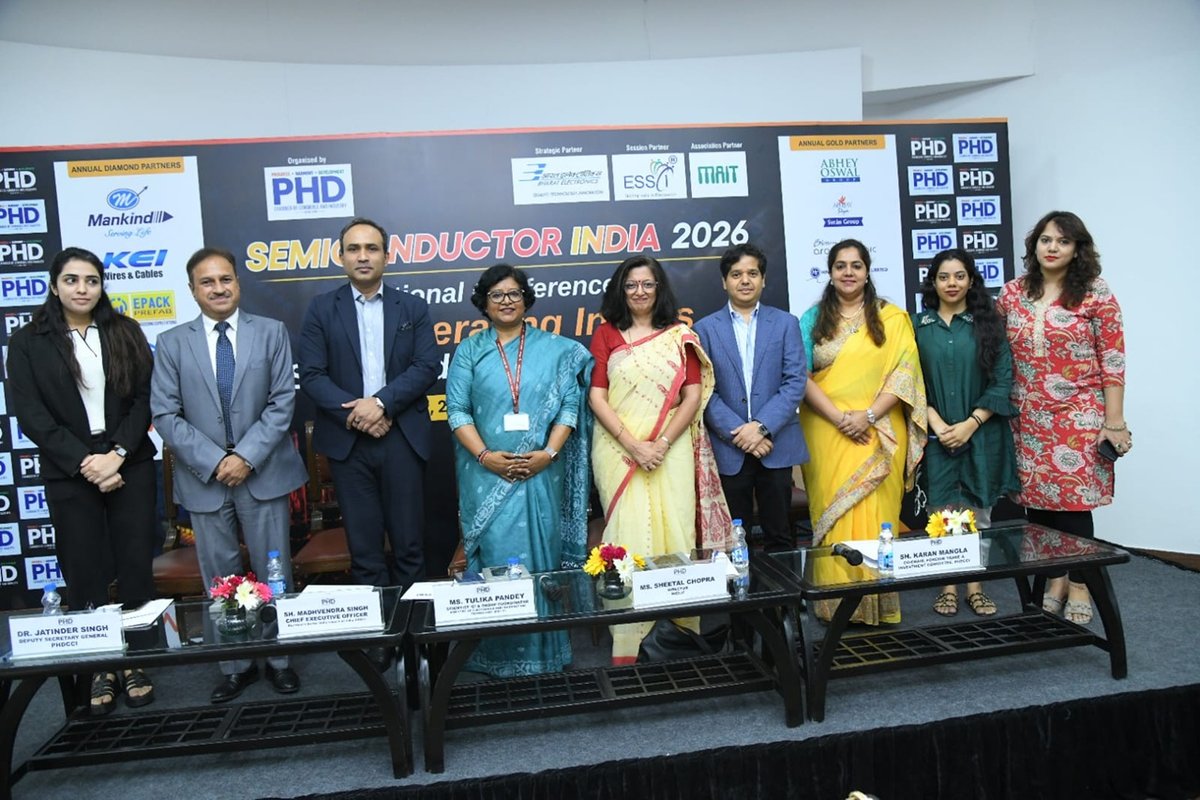
New Delhi | July 15, 2026
Synopsis:
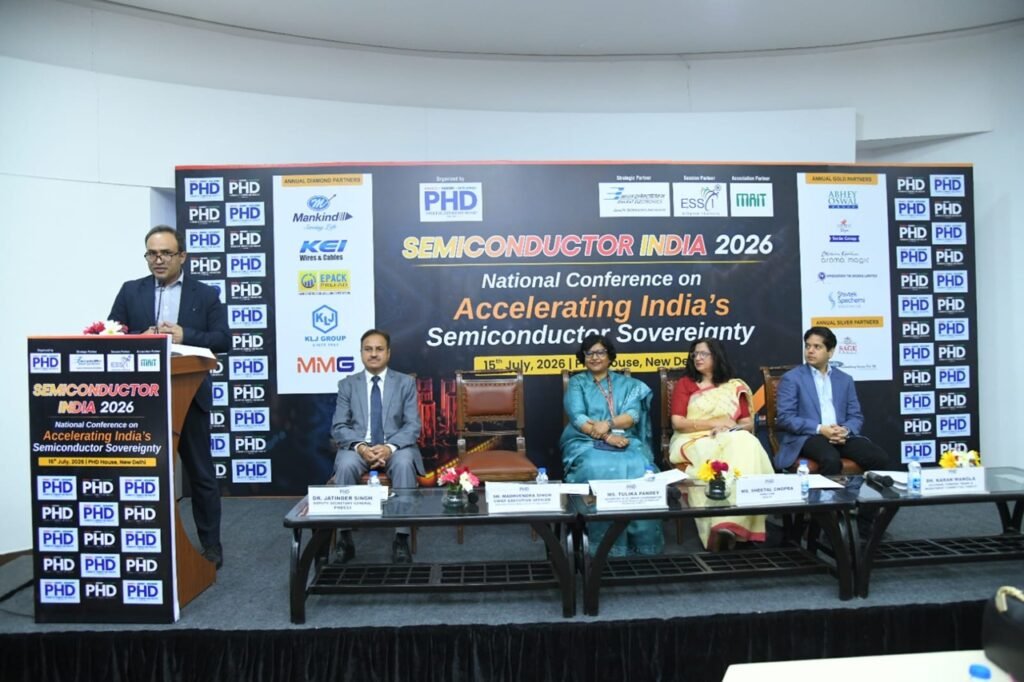
- Event: PHD Chamber of Commerce and Industry (PHDCCI) organized SEMICONDUCTOR INDIA 2026 at PHD House, New Delhi.
- Focus: Strengthening India’s semiconductor ecosystem through policy, manufacturing, innovation, skilling, and collaboration.
- Guests: Senior officials from MeitY, ESSCI, NIELIT, industry leaders, academia, MSMEs, and startups.
- Sessions: Deliberations on talent development, indigenous chip design, manufacturing scale-up, and supply chain resilience.
- Consensus: India’s semiconductor ambitions must be driven by policy stability, investments, infrastructure, skilling, and MSME integration.
Key Highlights from Leaders
Ms. Tulika Pandey, Scientist ‘G’ & Group Coordinator, MeitY (Guest of Honour):
- Semiconductor sovereignty extends beyond manufacturing to trusted technologies, resilient supply chains, secure infrastructure, and indigenous innovation.
- Government initiatives like India Semiconductor Mission (ISM) and ISM 2.0 are building a comprehensive ecosystem.
- MSMEs, startups, and innovators will play a defining role in shaping India’s semiconductor future.
Ms. Sheetal Chopra, Director, NIELIT (Special Guest):
- Human capital is India’s greatest advantage in the global semiconductor landscape.
- NIELIT’s 56 centres nationwide, specialized programmes in chip design, VLSI, embedded systems, and flagship initiatives like the Centre of Excellence in Chip Design, Noida are strengthening talent pipelines.
- Democratizing access to advanced technology education across Tier-II and Tier-III cities is critical.
Shri Madhvendra Singh, CEO, ESSCI (Special Guest):
- India’s semiconductor ecosystem is witnessing unprecedented momentum with 13 approved projects and investments exceeding USD 20 billion.
- Domestic semiconductor market projected to reach USD 130 billion by 2030.
- Expansion will require 400,000 semiconductor professionals and 1.5 million skilled workers across the value chain.
- MSMEs will be the backbone of component manufacturing, testing, packaging, and precision engineering.
Shri Karan Mangla, Co-Chair, Foreign Trade & Investment Committee, PHDCCI:
- India must translate policy momentum into large-scale manufacturing.
- Priorities include cleanroom readiness, power and water infrastructure, streamlined approvals, and resilient domestic supply chains.
- MSMEs are indispensable for specialty materials, precision engineering, and allied industries.
Dr. Jatinder Singh, Deputy Secretary General, PHDCCI:
- Semiconductors are the foundation of economic resilience, technological leadership, and national security.
- The conference provided a platform for policymakers, industry, academia, and MSMEs to co-create a roadmap for indigenous semiconductor growth.
Technical Sessions
- Building India’s Semiconductor Workforce: ISM 2.0 Training Mandate & Industry-Ready Talent
- From Policy to Production: ISM 2.0, Manufacturing Scale-Up & Indigenous Design
Deliberations covered manufacturing, chip design, talent development, advanced packaging, research, MSME integration, and supply chain resilience.
Consensus & Way Forward
Participants agreed that India’s semiconductor ambitions must be driven by:
- Policy stability
- Accelerated investments
- World-class infrastructure
- Robust skilling ecosystem
- Vibrant MSME network
By combining indigenous innovation, strategic partnerships, and talent development, India is well-positioned to emerge as a trusted global hub for semiconductor design, manufacturing, and innovation, contributing to Atmanirbhar Bharat and Viksit Bharat 2047.
 Keralam Home Minister Seeks Faster Interstate Action Against Drug Networks, Proposes Home Ministers’ Conference
 MEROO Launches Professional Nail Care Products in Bengaluru, Bringing Four Years of Research and Development to the Salon Industry