

Key Highlights:
- Rolls-Royce and IIT Kanpur have launched a joint research project focused on engine vibration-related aircraft cabin noise.
- The initiative follows a broader industry-academia collaboration formalised through a Memorandum of Understanding signed earlier this year.
- The six-month research project will examine structure-borne noise generated by engine vibrations.
- Researchers will validate a numerical methodology developed by Rolls-Royce using an experimental test rig at IIT Kanpur.
- The project aims to generate insights into vibration transmission and potential noise-reduction strategies.
- The initiative also supports knowledge exchange, research collaboration and talent development in advanced engineering.
Bengaluru, November 25, 2026
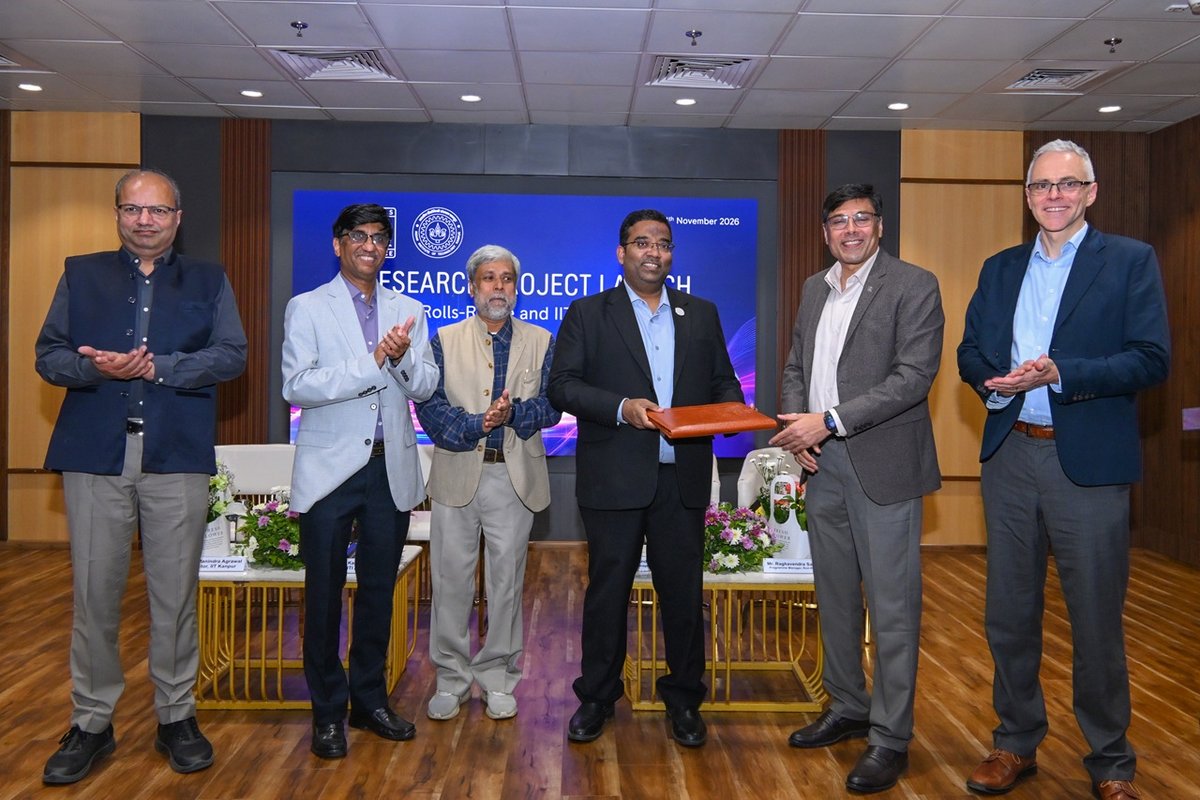
Rolls-Royce and Indian Institute of Technology Kanpur (IIT Kanpur) have announced the launch of a joint research project focused on understanding and reducing aircraft cabin noise generated by engine vibrations.
The project was formally launched at IIT Kanpur in the presence of senior representatives from academia, industry and government, including Prof. Abhay Karandikar, Prof. Manindra Agrawal, Andy Rix and Raghavendra Saroor.
Building on Industry-Academia Collaboration
The initiative follows a broader collaboration between Rolls-Royce India and IIT Kanpur formalised through a Memorandum of Understanding earlier in 2026.
The partnership framework includes cooperation across:
- Research projects
- Knowledge exchange
- Internship opportunities
- Skill development initiatives
- Academic-industry collaboration
The new project represents one of the first major research initiatives under the partnership.
Focus on Aircraft Cabin Comfort
The research programme will focus on understanding Engine Vibration Related Noise, an important factor influencing passenger comfort inside aircraft cabins.
According to Rolls-Royce, modern aircraft engines such as the Trent XWB already incorporate advanced low-noise technologies. The new project seeks to further understand how engine vibrations contribute to cabin noise and identify methods that could reduce these effects.
The findings are expected to contribute to future research on aircraft acoustic performance and passenger comfort.
Experimental Research Approach
The six-month project will focus on investigating structure-borne noise, which occurs when vibrations travel through physical structures and generate sound within the aircraft cabin.
The research will include:
- Validation of Rolls-Royce’s numerical methodologies
- Development of an experimental test rig
- Analysis of vibration transmission pathways
- Evaluation of aircraft cabin acoustics
A specially designed aircraft fuselage model will be created at IIT Kanpur to simulate real-world operating conditions.
Simulating an Aircraft in Flight
The experimental setup has been designed using a systems-engineering approach.
Key components include:
- Aircraft fuselage model
- Mechanical vibration source representing an engine
- Advanced acoustic sensors
- Vibration monitoring systems
- Integrated data acquisition systems
The setup is intended to mimic aircraft operating conditions and allow researchers to study the interaction between structural vibrations and cabin acoustics.
Researchers will use the system to gain deeper insights into vibration propagation and its impact on passenger environments.
Prof. Manindra Agrawal, Director, IIT Kanpur, said: “The Engine Vibration-Related Noise project offers an opportunity to investigate an important aspect of aircraft cabin comfort through a combination of numerical methodology and experimental validation.”
He added: “By establishing and using the experimental test rig at IIT Kanpur, the teams will work to generate reliable insights to inform further research into vibration transmission and noise-reduction strategies.”
Prof. Agrawal noted that the collaboration also aligns with IIT Kanpur’s broader efforts to strengthen its deep-tech ecosystem through research, technology translation, knowledge exchange and talent development.
Rolls-Royce on the Partnership
Sashi Mukundan, Executive Vice President, Rolls-Royce India, said: “At Rolls-Royce, we have a rich history of collaborating with academic institutions to support skill development, advance research and foster next-generation talent.”
He added: “Such partnerships play an important role in strengthening a collaborative ecosystem for innovation, supporting India’s ambitions in advanced engineering, research and manufacturing.”
Mukundan further highlighted the importance of internships and knowledge-sharing initiatives in providing students with practical experience and exposure to real-world engineering challenges.
Potential for Future Research
The aircraft noise programme is currently being undertaken as Phase 1.
The findings generated during this stage may inform future research into:
- Aircraft noise reduction
- Vibrational engineering
- Cabin acoustics
- Passenger comfort technologies
- Aerospace engineering solutions
The project also creates opportunities for additional collaborative phases based on initial outcomes.
About Rolls-Royce
Rolls-Royce develops technologies that power, protect and connect people around the world.
The company serves customers across:
- Aerospace
- Defence
- Marine
- Industrial sectors
Rolls-Royce operates in 47 countries and serves customers in more than 100 countries worldwide. In 2025, the company reported underlying revenue of £20.1 billion and underlying operating profit of £3.46 billion.
About IIT Kanpur
Established in 1959, IIT Kanpur is recognised as an Institute of National Importance by the Government of India.
The institute comprises:
- 21 academic departments
- 27 research centres
- 3 interdisciplinary programmes
- 3 specialised schools
With over 580 faculty members and more than 9,500 students, IIT Kanpur is among India’s leading institutions for science, engineering and technology research.
 KLAY Launches KOVE, India’s First Integrated Early Intervention Ecosystem, with a Commitment of 10 Million US Dollars to Expand Across India
 TiEcon Delhi-NCR 2026 to Convene Industry Leaders, Investors and Entrepreneurs
 Air India Express Enhances Mobile App, Announces 10% Savings on App Bookings