

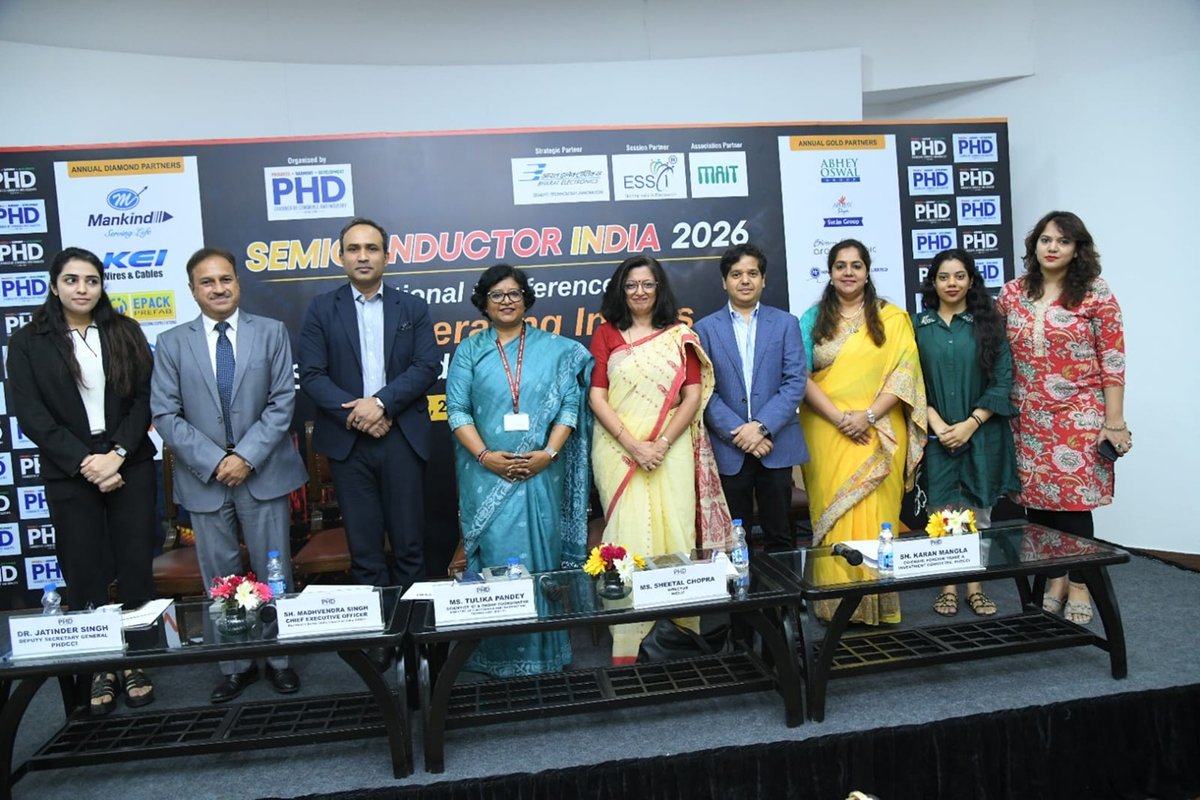
New Delhi | July 15, 2026
Synopsis:
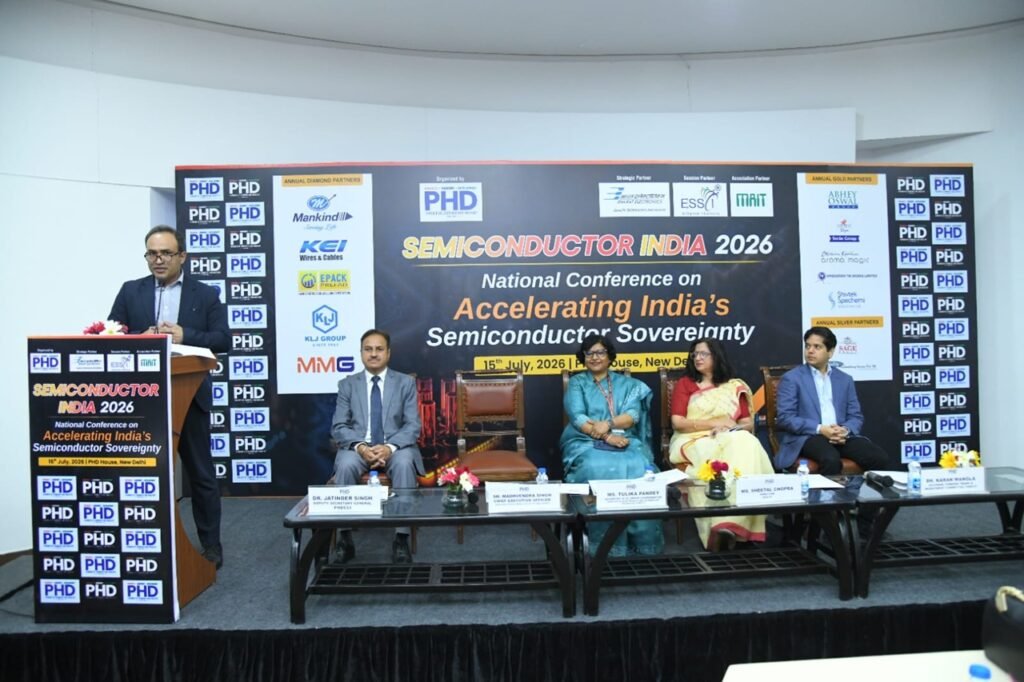
- Event: PHD Chamber of Commerce and Industry (PHDCCI) organized SEMICONDUCTOR INDIA 2026 at PHD House, New Delhi.
- Focus: Strengthening India’s semiconductor ecosystem through policy, manufacturing, innovation, skilling, and collaboration.
- Guests: Senior officials from MeitY, ESSCI, NIELIT, industry leaders, academia, MSMEs, and startups.
- Sessions: Deliberations on talent development, indigenous chip design, manufacturing scale-up, and supply chain resilience.
- Consensus: India’s semiconductor ambitions must be driven by policy stability, investments, infrastructure, skilling, and MSME integration.
Key Highlights from Leaders
Ms. Tulika Pandey, Scientist ‘G’ & Group Coordinator, MeitY (Guest of Honour):
- Semiconductor sovereignty extends beyond manufacturing to trusted technologies, resilient supply chains, secure infrastructure, and indigenous innovation.
- Government initiatives like India Semiconductor Mission (ISM) and ISM 2.0 are building a comprehensive ecosystem.
- MSMEs, startups, and innovators will play a defining role in shaping India’s semiconductor future.
Ms. Sheetal Chopra, Director, NIELIT (Special Guest):
- Human capital is India’s greatest advantage in the global semiconductor landscape.
- NIELIT’s 56 centres nationwide, specialized programmes in chip design, VLSI, embedded systems, and flagship initiatives like the Centre of Excellence in Chip Design, Noida are strengthening talent pipelines.
- Democratizing access to advanced technology education across Tier-II and Tier-III cities is critical.
Shri Madhvendra Singh, CEO, ESSCI (Special Guest):
- India’s semiconductor ecosystem is witnessing unprecedented momentum with 13 approved projects and investments exceeding USD 20 billion.
- Domestic semiconductor market projected to reach USD 130 billion by 2030.
- Expansion will require 400,000 semiconductor professionals and 1.5 million skilled workers across the value chain.
- MSMEs will be the backbone of component manufacturing, testing, packaging, and precision engineering.
Shri Karan Mangla, Co-Chair, Foreign Trade & Investment Committee, PHDCCI:
- India must translate policy momentum into large-scale manufacturing.
- Priorities include cleanroom readiness, power and water infrastructure, streamlined approvals, and resilient domestic supply chains.
- MSMEs are indispensable for specialty materials, precision engineering, and allied industries.
Dr. Jatinder Singh, Deputy Secretary General, PHDCCI:
- Semiconductors are the foundation of economic resilience, technological leadership, and national security.
- The conference provided a platform for policymakers, industry, academia, and MSMEs to co-create a roadmap for indigenous semiconductor growth.
Technical Sessions
- Building India’s Semiconductor Workforce: ISM 2.0 Training Mandate & Industry-Ready Talent
- From Policy to Production: ISM 2.0, Manufacturing Scale-Up & Indigenous Design
Deliberations covered manufacturing, chip design, talent development, advanced packaging, research, MSME integration, and supply chain resilience.
Consensus & Way Forward
Participants agreed that India’s semiconductor ambitions must be driven by:
- Policy stability
- Accelerated investments
- World-class infrastructure
- Robust skilling ecosystem
- Vibrant MSME network
By combining indigenous innovation, strategic partnerships, and talent development, India is well-positioned to emerge as a trusted global hub for semiconductor design, manufacturing, and innovation, contributing to Atmanirbhar Bharat and Viksit Bharat 2047.
 Happy Cultures Adds a Dubai Kunafa Twist to the Protein Category with Its Latest Launch